This is the increasingly common view of younger generations within the cultural and creative industries. We can no longer think of our future without permeating disciplines and encouraging exchanges. Jeanne Vicerial does not wish to define her work simply, nor does she wish to meet standards. Her experience shows how difficult it is for young artists who aspire to mix disciplines to position themselves in the art world.
Jeanne Vicérial
16.04.22
"To conceive of creative practice without going through the collaborative process is an intergenerational bug"
From an early age, Jeanne was influenced by the performing arts, which her parents loved. Costumes play a central role in this; allowing actors to slip into the skin of various characters, they give them a certain freedom of movement and with it, a new meaning to each new skin. Jeanne wants to learn the history of costume, so in 2009, she enters the Paul Poiret school in Paris, one of the only public costume schools, where she studies 19th century women's costumes, and learns how to make them to measure.
A first experience marked her: she prepares the Christian Lacroix exhibition at the Musée des Arts Décoratifs, for which the clothes do not have models. The process had to be reversed and bodies had to be modelled to fit the creations. Moreover, the training at the school is technical and requires meticulousness; Jeanne learns to work for a creative, and to make a model from an initial drawing, but at the slightest mistake, even if it is only a few millimetres, she is asked to start again. As the school is film-oriented, she is working on a docu-drama for Michael Radford, but does not like this position. For Jeanne, costume designers are not given the recognition they deserve in the fashion world. Also, she needs creative freedom in her work.
In 2011, she starts a course at ENSAD, where she studies ready-to-wear. It is a century-long leap into the industrial sphere where the individual is hardly taken into account, and this is the origin of the first reflections that lead her to write her famous thesis. But that is not all; the split between art and design is being heavily felt, and access to different disciplines can only be achieved through a double degree. She leaves for the London College of Fashion for a year in 2013, where she learns leatherwork and leather techniques, which are quite similar to surgery. She takes advantage of her stay in England to do an internship at the studio of Hussein Chalayan, a designer known for his innovative ideas, his experiments and his ability to mix artistic disciplines with new technologies. On her return to France, Jeanne, who would also like to mix several in her practice from the genesis of her projects, decides to found her own studio: CLINIQUE VESTIMENTAIRE.

Photo credit : Joseph Schiano di Lombo
At first, Jeanne has fun, studies, experiments with sewing techniques, and creates her first collections, between school and various collaborations.
But the brands and fashion houses reject the concept, asking her to make it more commercial, and to make ready-to-wear. The decreasing model does not suit, and Jeanne focuses only on research for a while, which is, in her opinion, pure and liberated.
Reading the Anti-Fashion Manifesto written by Lidewij Edelkoort in 2015 was a landmark episode for CLINIQUE VESTIMENTAIRE; the fashion industry had fallen ill, she says.
Jeanne already has an ecological and humanistic approach, and feels comforted by the rejection of some brands. But she gives her project an even more critical dimension as she makes these two aspects her battle horses.
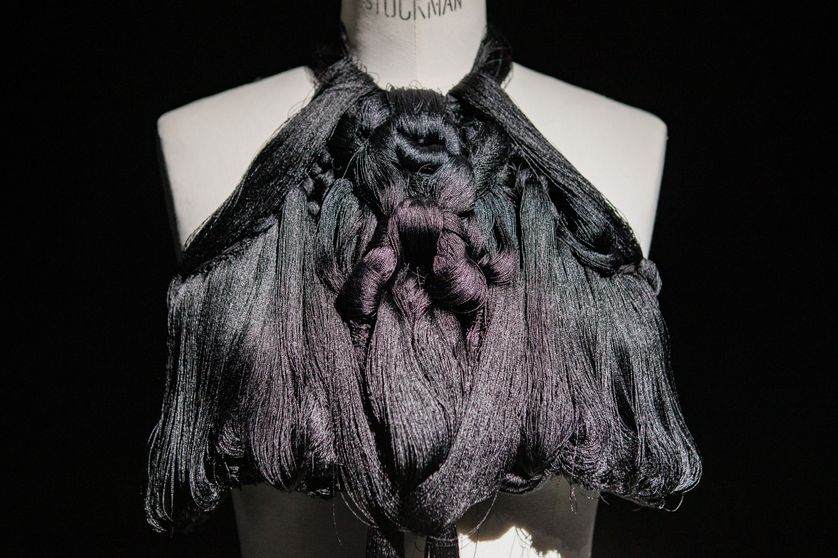
The porosity between disciplines remains an element dear to the artist's eyes, and takes another turn when she implements her idea of a tricotissage "robot", letting new technologies invite themselves into her project. As part of her SACRe doctorate between 2015 and 2018, she collaborates with HND and Ecole des Mines students, with whom she files a patent. The programme is based on a mode of operation that validates hypotheses through experimentation, a model that she finds satisfactory.

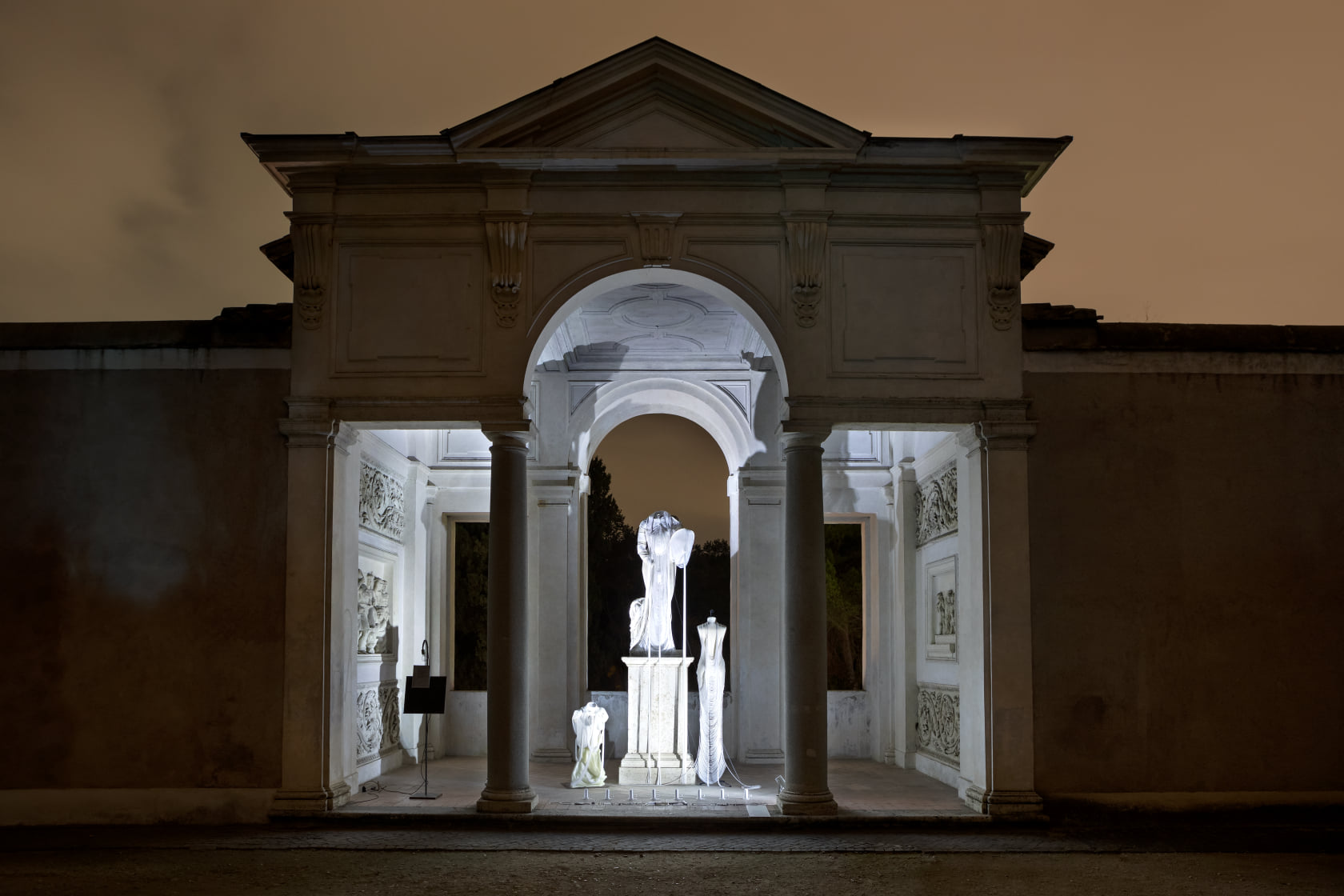
With time, CLINIQUE VESTIMENTAIRE also unfolds in a performative aspect; Jeanne leaves for a residency at the Villa Medici in Rome, where she experiences the first days of the pandemic a little ahead of France. The relationship to time is different, a feeling we all know by now, and the artist makes it her mission to post a photo a day on Instagram to keep up with the work. For the first time, she manipulates colours and light, creating clothes with flowers from the garden, waiting for materials that have become inaccessible. And because she can't touch other people, she uses her own body as a medium by making self-portraits. Photographer Leslie Moquin joins her on site and produces an almost documentary series in which, together, they stage her creations.
Named Quarantaine Vestimentaire (clothing quarantine), the project was built around the first 40 days of lockdown; one clothing composition per day, more than 250 photographs, and numerous mythological and historical references, evoke an actress who changes her skin over the course of the day, in a grandiose setting. Together with the faded flowers, these ephemeral creations perfectly illustrate the artist's comments on movement and the idea of change. Moreover, when asked to lend her collection for Fashion Week, Jeanne can only refuse.

Photo credit : Leslie Moquin
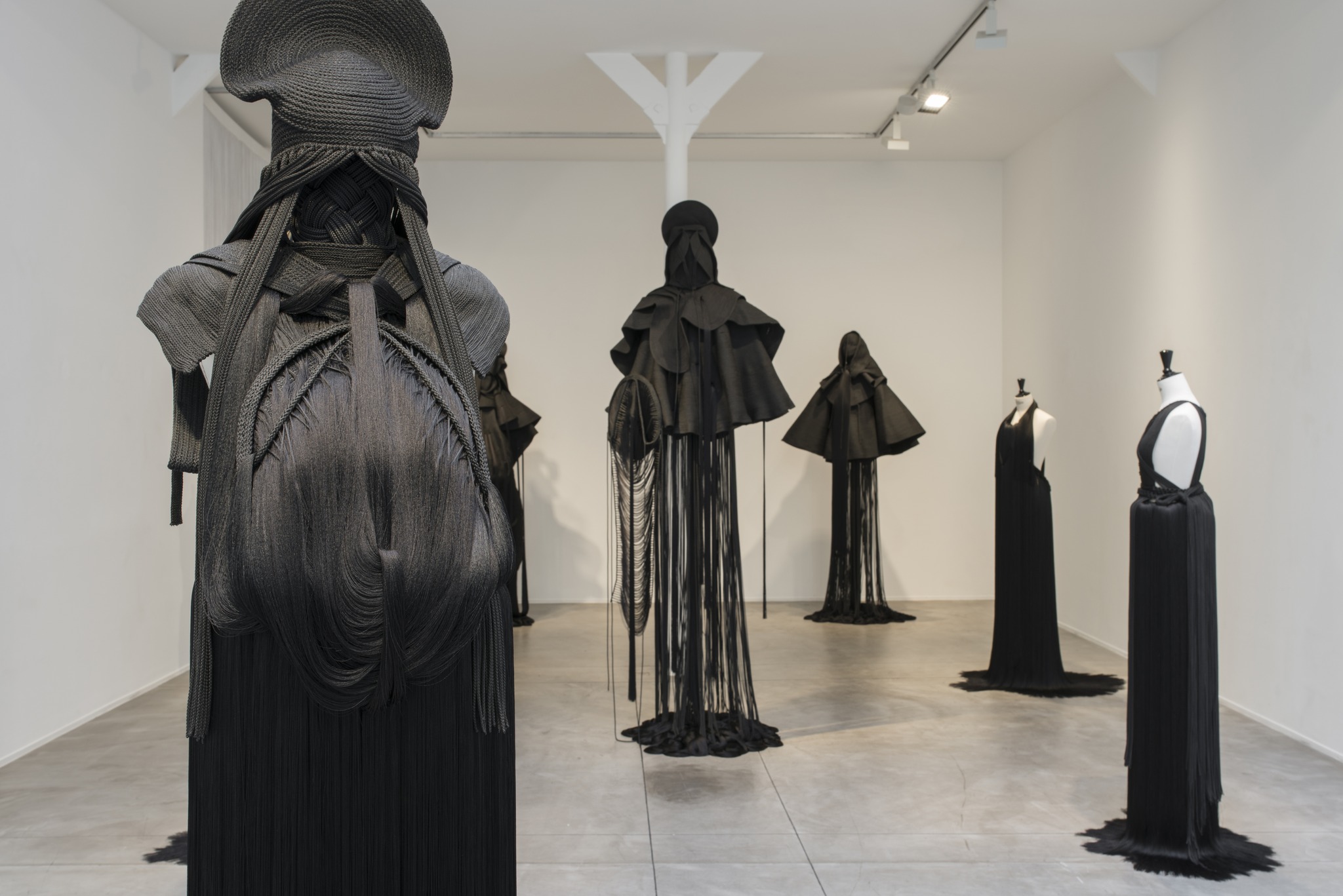
The role of exhibitions is also becoming more and more important; they allow Jeanne to show all the facets of the creative process, from the simple tool to the final creation. As we saw during the exhibition at the Magasins Généraux, she seeks to put forward her varied artistic collaborations, to mix universes and to confront the public with them during the numerous events organised for the occasion. In an approach of knowledge transmission, she also proposes conferences and offers creative workshops in art schools.
More recently, she returned to her first love on the stage of the Grand Théâtre of Geneva, for which she produced the costumes for the opera Atys composed by Jean-Baptiste Lully, choreographed by Angelin Prejlocaj. Her next appearance is at the Galerie Templon, which represents her and is dedicating an exhibition to her work in its Brussels space until 23 April 2022.

Photo credit : Gregory Batardon
Over time, Jeanne has turned CLINIQUE VESTIMENTAIRE into an umbrella of diverse projects that are collaborative and multidisciplinary, and against institutions whose model paralyses creation.
Jeanne Vicerial wanted to heal the fashion world, but she did much more; by thinking the system differently, she made room for those who could not find any.
Artist
Project
CLINIQUE VESTIMENTAIRE
Related Projects and Articles
Textile artist Jeanne Vicerial explores alternatives to ready-to-wear fashion / Focus
Fashion, and fast fashion in particular, has many harmful effects: pollution, modern slavery, the disappearance of know-how... Jeanne Vicérial proposes a rethink of the industry and a return to a healthy balance.Read more
CLINIQUE VESTIMENTAIRE / Behind-The-Scenes
CLINIQUE VESTIMENTAIRE is an umbrella of research, performative and critical projects that aim to provide alternative solutions to the textile industry.Read more