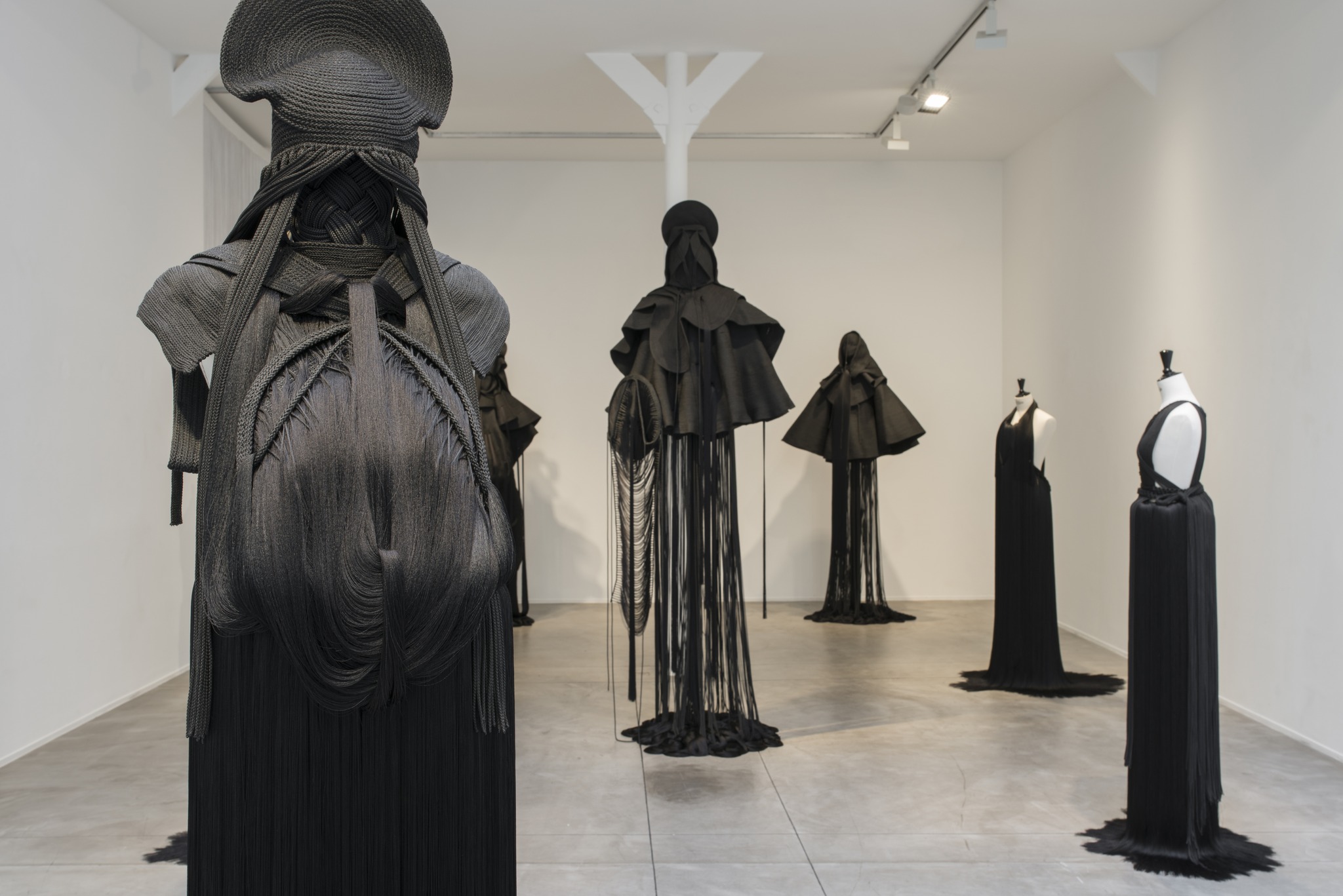
Paris, Milan, London, New York .. The names of these cities evoke their effervescence and their lights, strongholds of culture, and above all the fashion capitals of the world. Between the catwalks of Fashion Week, the crowded streets of working-class neighbourhoods, and the cinema screens, fashion is everywhere. It is as captivating as its industry is harmful to humans and their environment. Among the issues at stake, the place of the human body in the clothing production process is the subject that Jeanne Vicerial takes up; what happens when we put it back at the heart of the machinery? Can industrial methods be thought of differently?
The artist-researcher brings her vision through her CLINIQUE VESTIMENTAIRE (clothing clinic) project, at the crossroads of craft, philosophy, and science.
CLINIQUE VESTIMENTAIRE
CLINIQUE VESTIMENTAIRE has its origins at the École des Arts Décoratifs in Paris, where Jeanne wrote a thesis in 2014 entitled Un corps sur mesure, la peau étoffe du XXIe siècle (A tailor-made body, the fabric skin of the 21st century). The publication takes stock of her thoughts at the time; historically, clothing is created according to the silhouette of the client or customer, known as 'bespoke', but from the 1950s onwards, the textile industry experiences a major turning point. The Second World War overturns production methods in favour of standardised and faster assembly-line processes, which contributes to the advent of ready-to-wear clothing. The human body is now an object like any other, standardised according to a grid of sizes (S, M, L), and it is now up to the customer to adapt to the clothes.
Worse still, we modify our bodies to fit these standards: nutrition, sport, plastic surgery... Tattoos act as tailor-made jewellery, because made-to-measure is always there in another form, and the skin has become the fabric of the 21st century.
It is also the largest organ in the human body, and provides protection to our tissues and other internal organs. As a natural barrier to the outside world, the skin envelops the self, our spirit, our dreams, our unique way of thinking. Jeanne considers the individual as a whole, interested in the bodily transformations that tell us her personal story. Although she does not exclude men, she is more interested in women's bodies, whose morphology is in constant mutation, whether it is due to menstruation, or to the punctual events that mark their bodies.

Jeanne now has to make a collection as part of her studies, she researches morphology, the starting point of her work, and marvels at the discovery of muscle weaves. For her, this is the first garment.
Jokingly, the artist calls herself a " clothing surgeon ", operates on parts of garments, and ends up being seriously inspired by medical procedures, even spending time in various laboratories.
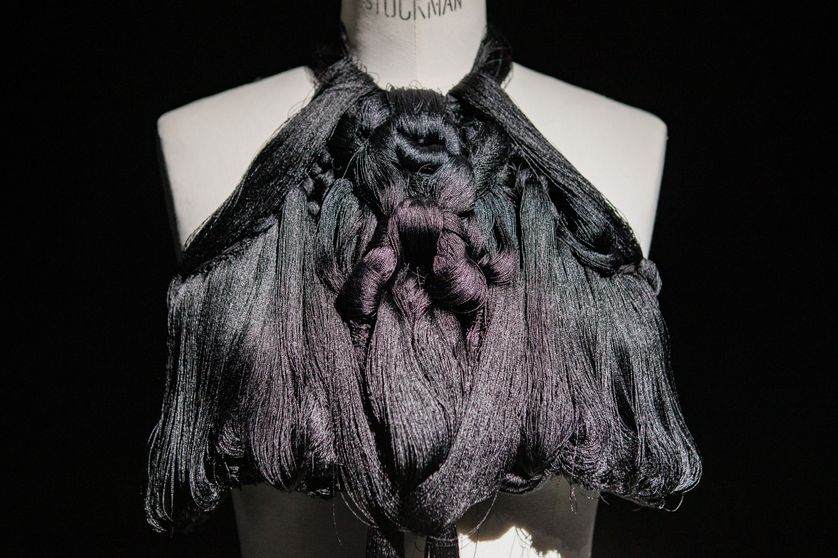
She developed the technique of "tricotissage", a mix between lace, knitwear and weaving, which uses the doctor's curved needle to make the stitches. The aim is to produce the garment with a single spool of thread, by hand, made to measure, without offcuts and locally. Also inspired by muscle tissue, knitting takes a monofilament yarn (a strong, flexible, single-filament yarn), and connects the stitches geometrically.
In order to remain ecological and economical, she uses scraps discarded by Parisian companies, and her first collection is named after the length of the spool, 466 km of thread. But the last piece, whose thread is badly dyed, takes on a flayed appearance, turning bright red, an intense vision. Despite the success of the project, Jeanne abandons the idea of making such long pieces by hand.
This creation meets the objectives that she has set herself. She therefore pushes her thinking further; automating the tricotissage technique makes it possible to offer clothes based on the same criteria, with the advantage of saving time. She then embarks on the design of a digital craft machine, enabling her to make "tailored-to-wear" garments.
The research on the construction of the tool requires prolonged and sustained efforts, so Jeanne starts in parallel to make a new collection.
Still thinking about tailored-to-wear, she has the idea of creating a system of adaptable sizes ranging from 36 to 42, using classic sewing techniques. But she quickly comes up against the reality of the market; despite a few retailers and manufacturers who also seek to facilitate the transition to more ethical and sustainable fashion, the project is generally not well received.

Jeanne works in a logic of degrowth; the creation of unique pieces is not adapted to the laws of the seasons and the current market. This experience strengthens her in the idea that she must deepen her research in the field of textiles and mechatronics. She prefers to create her laboratory workshop, a place of prototyping and creation, where she continues to develop her thoughts. In 2016, the construction of the tricotissage machine begins, in partnership with the Ecole des Mines de Paris, and within the framework of her SACRe (Art, Science, Creation and Research) thesis at ENSAD.
To understand how it works, we can refer to the model of the 3D printer; on a flat surface, the machine is programmed to come and plant the needles with a system of clamps, they form the pattern of the garment. The single thread then connects these points. Software is also used to visualise the machine's movements in real time, to control it, and even to run full simulations.
With the filing of a patent with the INPI, tricotissage becomes a new technology.
Its use is evolving with the research, and at the moment it is as follows: Jeanne meets the person, takes their measurements, and draws the garment. The machine takes the information gathered by the artist, but is only semi-automated, an important element for the process that can be stopped at any time, to redesign the creation for example. Most importantly, the hours are now converted into minutes.
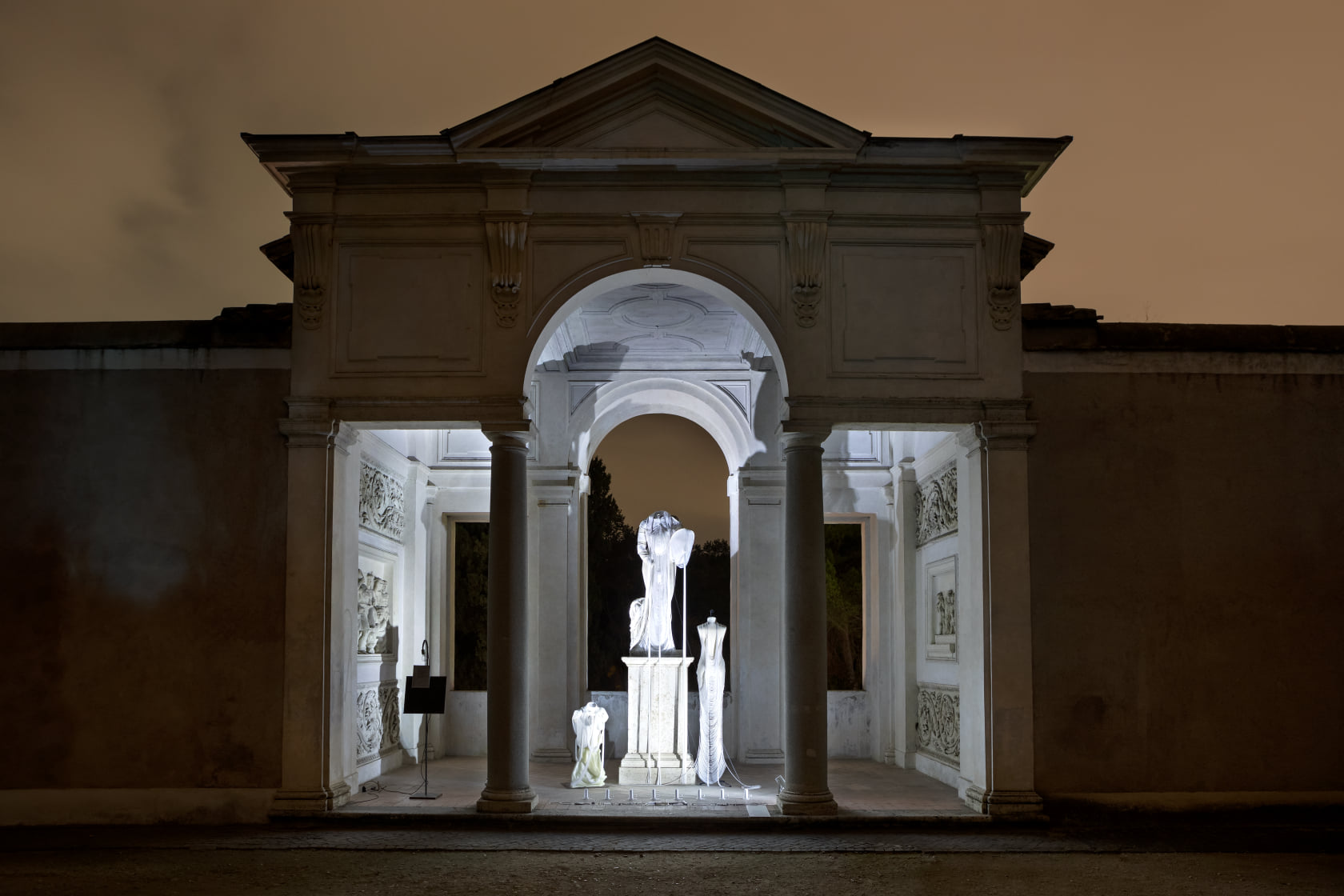
Today, with the Soft Matters research group of which she is a member and within the ENSAD Lab, Jeanne and the team of partner engineers continue to develop the machine, which remains her core subject. Nevertheless, her artistic practice is not limited to the tool, quite the contrary. Her residency at the Villa Medici in Rome in 2019-2020 allows the project to take on an unexpected scope. By mixing artistic mediums and including staging in her project, she orchestrates performances in which she combines the human, the garment and nature to tell us a story, around the values that animate her.

CLINIQUE VESTIMENTAIRE is composed of various projects, and their exhibitions immerse visitors in a unique universe. Jeanne, always in a collaborative approach, invites other artists to bring their works to life with hers.
From a simple thesis a vast performative and critical project was born.
Guided by her convictions, Jeanne Vicerial opens up an alternative path of practices and approaches for the textile designers of tomorrow.
CLINIQUE VESTIMENTAIRE
Related Projects and Articles
Jeanne Vicérial / Portraits