obsolete.studio
En / Fr

Mythology
Heritage
 / Behind-The-Scenes

The Lights Which Can Be Heard

Diane Pricop
11.02.22

Immediately this keyboard, streaked with gold and agate,
Turns into a curtain whose whiteness bursts,
[...]
What is this strange veil or rather this wonder?

This passage from the poem The Aurora Borealis, written in 1904 by the Canadian William Chapman, sums up the impression we have of the phenomenon quite well. Dancing lights in the sky, their enigmatic aspect fascinates, and feeds our imagination on the myths and traditions of the northern peoples. Difficult to capture, not many of us have the opportunity to witness this spectacle, but for the few who are lucky enough, some would be able to perceive sound; is it real? Do the Northern Lights emit sound? In his project The Lights Which Can Be Heard, Sébastien Robert shares his vision and immerses us in the far reaches of the Norwegian fjords.

The idea comes from his interest in the Sami people, who live in the northern lands from Sweden to Russia and are considered by the UN to be the last indigenous and nomadic peoples in Europe. We have heard about them in the news for their sad fate in the face of industrial giants invading their territories for natural resources. Once again witnessing a history that is repeating itself, Sébastien begins researching their rituals and musical traditions, likely to be eclipsed in time.

He begins by finding writings on Sàmi rituals involving minerals in the Arctic subsoil and the aurora borealis. In the Sami language, the phenomenon is called 'guovssahas', which literally means 'lights that can be heard'; Sébastien will travel to the area to research the sound of the aurora borealis, and to study the local traditions related to the subject. The idea is appealing and he is selected for a STRP ACT AWARD 2022, which allows him to plan his field trip.

Sébastien spots the space centre on the island of Andøya in Norway, and contacts their team to discuss a possible collaboration on the scientific part of his work. He then learns that the aurora borealis belong to outer space, and therefore to the military, and the data collected will not be communicated. Without giving up, Sébastien goes back to the books, but this time he focuses exclusively on the aurora borealis.

In partnership with the Royal Library in The Hague, he is given privileged access to the archives and comes across a book that will become his future bible: Northern Lights, From Mythology to Space Research. One chapter catches his eye: it reports the stories of people who hear them, and the related scientific research. The book, published in 1983, is inconclusive on the subject, but it is enough to give our artist a glimmer of hope. The further he goes, the more the accounts multiply; over the centuries and in different places on the planet, individuals have heard sounds at the sight of the aurora borealis and their descriptions are incredibly consistent.

History tells us that it was only after the Second World War that theories formulated in the 1920s resurfaced. One of them, which Sébastien is seriously considering, is that the VLF (very low frequency) electromagnetic waves produced by the aurora could be perceived by the human ear through natural elements.

To better understand this, let's take a brief definition of a radio wave: it is an electromagnetic wave produced by electric charges moving through the air at very high speed. When they move, they oscillate more or less quickly in time. The frequency is defined by the number of oscillations in one second (measured in Hertz), and by the distance between them. Waves are classified according to their frequency in the "electromagnetic spectrum". The term radio defines a category of waves in this spectrum. We tend to think that radio waves are a human invention, but they have been around since the dawn of time. Many natural phenomena (lightning, solar winds, aurora borealis) disturb the earth's magnetic field and thus create electromagnetic waves.

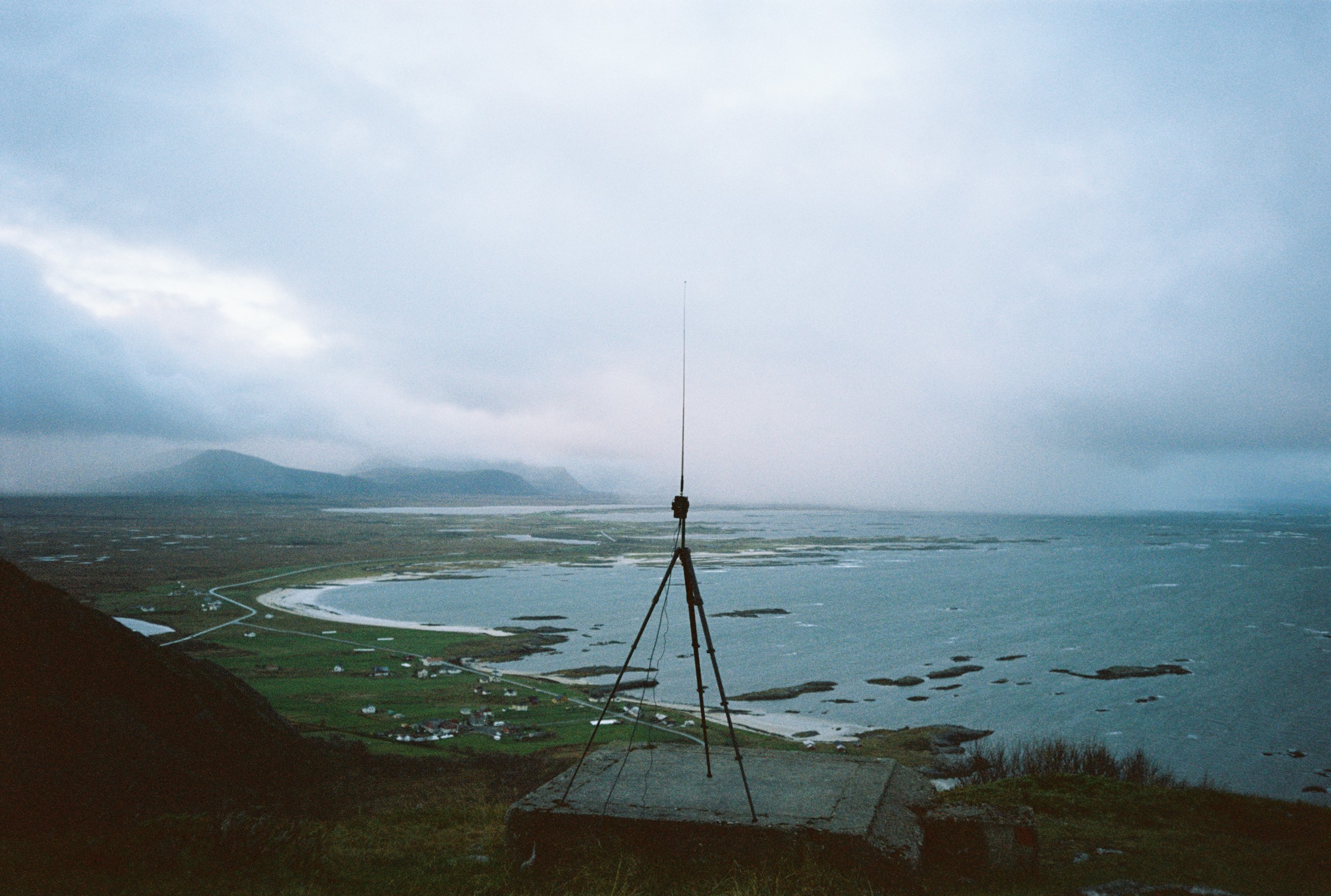
Until proven otherwise, we cannot hear radio waves directly, we need a device to translate the waves into sound. The theory reveals that certain elements in nature would be a way of doing this sound translation. But before going too far, Sébastien wants to check the first part of the theory and gets a receiver that will allow him to pick up the waves.

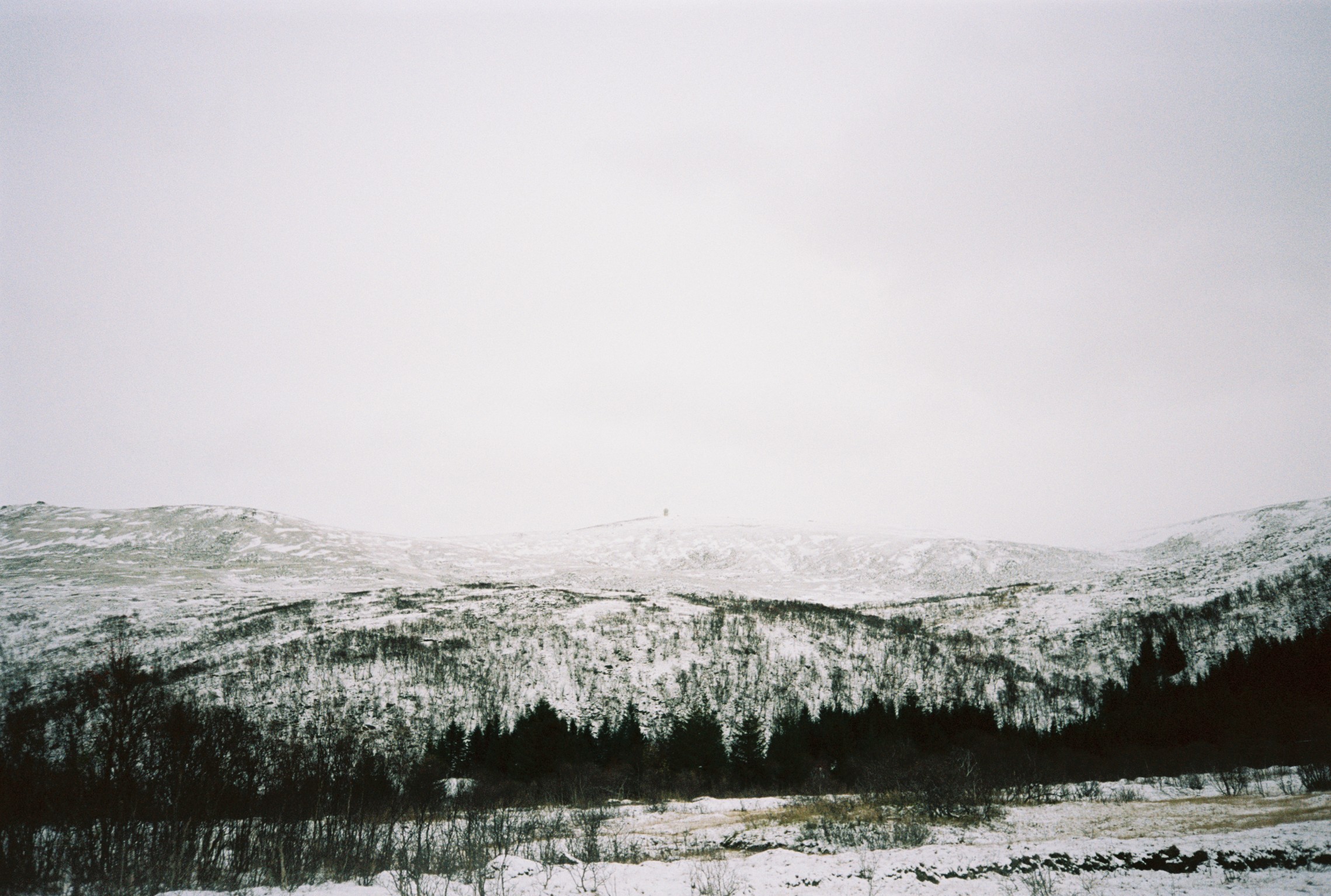
Now settled on the island of Andøya for a three-week residency, Sébastien is exploring his terrain, hiking day and night. The first difficulty is to find the right place to stand and wait, he must not go far from his base in case he has to leave urgently for the field, but must be far enough away not to pick up waves created by any human activity. Because any electronic device creates VLF waves, and to avoid them one has to be 2 or 3 km away. He eventually found a spot 45 minutes walking distance. The second challenge is a natural one; we are in October 2021, an intermediate period that should allow Sébastien to do his research by day and night, only the geomagnetic forecasts are not favourable. But on the night of the 11th to the 12th, a geomagnetic storm breaks out, Sébastien prepares his equipment and spends the night in the mountains, successfully recording the aurora borealis.

The encounter with the indigenous peoples represented an additional obstacle for the artist who, for the first time in his career, set off alone on this expedition. It is during the last week of his residency, as a guest of the Insomnia festival, that he has the opportunity to draw attention to his project and to meet some interested parties who answer his questions : Contrary to what the writings studied during the genesis of the project suggested, the term "guovssahas" is in reality only an urban legend, and the aurora borealis has only a minor symbolic place in Sami culture. But if the sound of the aurora is well known to the inhabitants of the different regions of the Arctic, and is the subject of stories told by their ancestors, Sébastien has not met anyone who has actually experienced it.
Sebastien returns to the Netherlands, and continues his research on minerals that have the property of changing one energy into another, to make the famous translation: piezoelectric crystals, mainly quartz; they carry an electrical charge and react to mechanical pressure. This is the reason why this mineral is so sought after for the proper functioning of our electronic devices.

In preparation for the presentation of his project at the STRP festival in Eindhoven, Sébastien is working on how to connect all these elements. We will have the opportunity to discover an immersive and interactive installation, a play of sounds, lights and perceptions, around a subject still open to debate in 2022.

As for the testimonies of experiences, the game is perhaps only postponed; Sébastien returns to Norway to set up a permanent antenna on the site, and in parallel, launches a call for witnesses through an online exhibition at the AyarKut Foundation in Russia.

We cannot explain everything to ourselves, and myths are born of these gaps. Sébastien Robert does not try to fill them in, he opens up an artistic path; an alternative between science and intuition, all in poetry.

Commissioned by
With the financial support of

Dispositif pour la Création Artistique Multimédia et Numérique (DICRéAM), and Stroom Den Haag.

Initiated during

the Arctic Wave residency programme

Under the artistic supervision of

Jean-Emmanuel Rosnet

With the intellectual support of

The Royal Library of the Netherlands
Njål Gulbrandsen (Tromsø Geophysical Observatory)
Fiona Armery (University of Cambridge)
Rob Stammes (Polarlightcenter)
Harald Gaski (The Arctic University of Norway)
Hans Ragnar Mathisen
Matti Aikio.