obsolete.studio
En / Fr

Ecology
Design
Biology
 / Behind-The-Scenes

Pyrocumulus

Diane Pricop
25.11.23

The planet is on fire.

The year 2023 broke all records, with fires ravaging millions of hectares of land from Canada to Hawaii, via the Mediterranean basin, and making the inhabitants of these regions regulars of ecological disasters. Forest fires, whether of natural origin or not, are multiplying exponentially, a significant symptom of the human impact on the environment. This has not escaped the attention of artist-researcher Alizée Armet, who is proposing a singular way of understanding these fires through her project, Pyrocumulus; at the crossroads of biology, augmented reality and the history of the Landes woodland, she is exploring the ways in which trees communicate during and after these climatic episodes.

For Alizée, it all begins in the summer of 2021, when she is staying with her family near Anglet in the Pyrénées-Atlantiques region. First the smell, then the huge cloud of smoke herald the fire in the nearby Chiberta forest. Although the subject of mega fires had been nagging at her for some time, it is this particular one that triggers her desire to make it the subject of a project. There follows an extraordinary media coverage due to the fact that the region suffers three major fires during this period, and that in the rest of the world the same thing happens. In addition to this flurry of information, Alizée is intrigued by people's behaviour in the face of the fires. In her research, she comes across people filming themselves in front of the flames, whether to raise awareness or simply to create a buzz. So she asks herself: how has our relationship with the forest changed? Has our use of technological tools created or contributed to our distancing ourselves from nature, and by extension natural disasters?

These behaviours are in fact culturally rooted in Western civilisations. The history of the Chiberta forest provides some clues; the area has undergone many geographical changes due to the desire to divert the mouth of the River Adour to facilitate maritime trade, and the first major works date back to the Middle Ages. The changes in the course of the river left traces of sand on which Napoleon III, in the 19th century, planted the artificial reserve of pine trees that we know as the "Chiberta forest". Aesthetically pleasing, but also useful for purification, it has gradually become a leisure area. In fact, the Landes massif, which is artificial, was only planted to meet a specific need. However, examples of the transformation of natural territories to meet human needs date back to the earliest civilisations, but in the Western world, the logic developed into philosophy (Descartes, Rousseau, etc.), which in turn influenced politics and society. Here, the tree is a consumer good like any other, which would explain our distant relationship.

Alizée, who already has an idea of the project she is going to carry out, takes her research further by going out into the field with her graphic designer colleague Isabelle Lazcanno, where they gather information for two or three months after the fires in the Landes. In this macabre setting, where the wood and soil had been burnt to a crisp, she discovers living mushrooms at the foot of the trees. She already knew that they communicated via networks of mycelium, but not that this communication continued after the death of the tree. This phenomenon is due to "mycorrhizae", a term used to describe the union between a fungus and the root of a plant. Everything happens underground. When the union is out of balance, for example when the plant dies, the fungus can recycle the dead organic mass of the plant to generate new offspring, and continue to grow. In fact, the presence of mycorrhizae considerably accelerates plant regeneration and proliferation.

The artist pushes her thinking further by comparing the history of the Landes woodland and the workings of mycorrhizae; for her, these trees are mutants, both colonised and fragile. They have been planted by humans as monocultures, which makes them more vulnerable to disease and the spread of fire, but they also have their own means of survival. At the same time, she comes across the work of Stephen Pyne, who talks about the "pyrocene" era; for him, the mastery of fire by humans became damaging to the environment in a lasting way when fossil fuels came into use. This has helped to exacerbate the effects of global warming, causing mega-fires which in turn amplify global warming in an endless vicious circle. Their smoke and ash collect in clouds that contain various biological data. The project will be named after this type of cloud: Pyrocumulus.

In 2022, Alizée applies to the Cultures Connectées call for projects launched by the DRAC and the Nouvelle-Aquitaine region, which requires a demonstrative outcome. Her choice of cultural partnership is Accès Cultures Electroniques, where the exhibition of her installation will take place, and where she meets Jean Jacques Gay, director of the association, who advises her on the artistic direction of the project. The idea is to recreate the communication system of trees after a fire, putting it in parallel with our technological tools and making it interactive for the public. To put all this into practice, she calls on Patxi Bérard and Denis Geral, two engineers from ESTIA school, to help her develop the devices she needs.

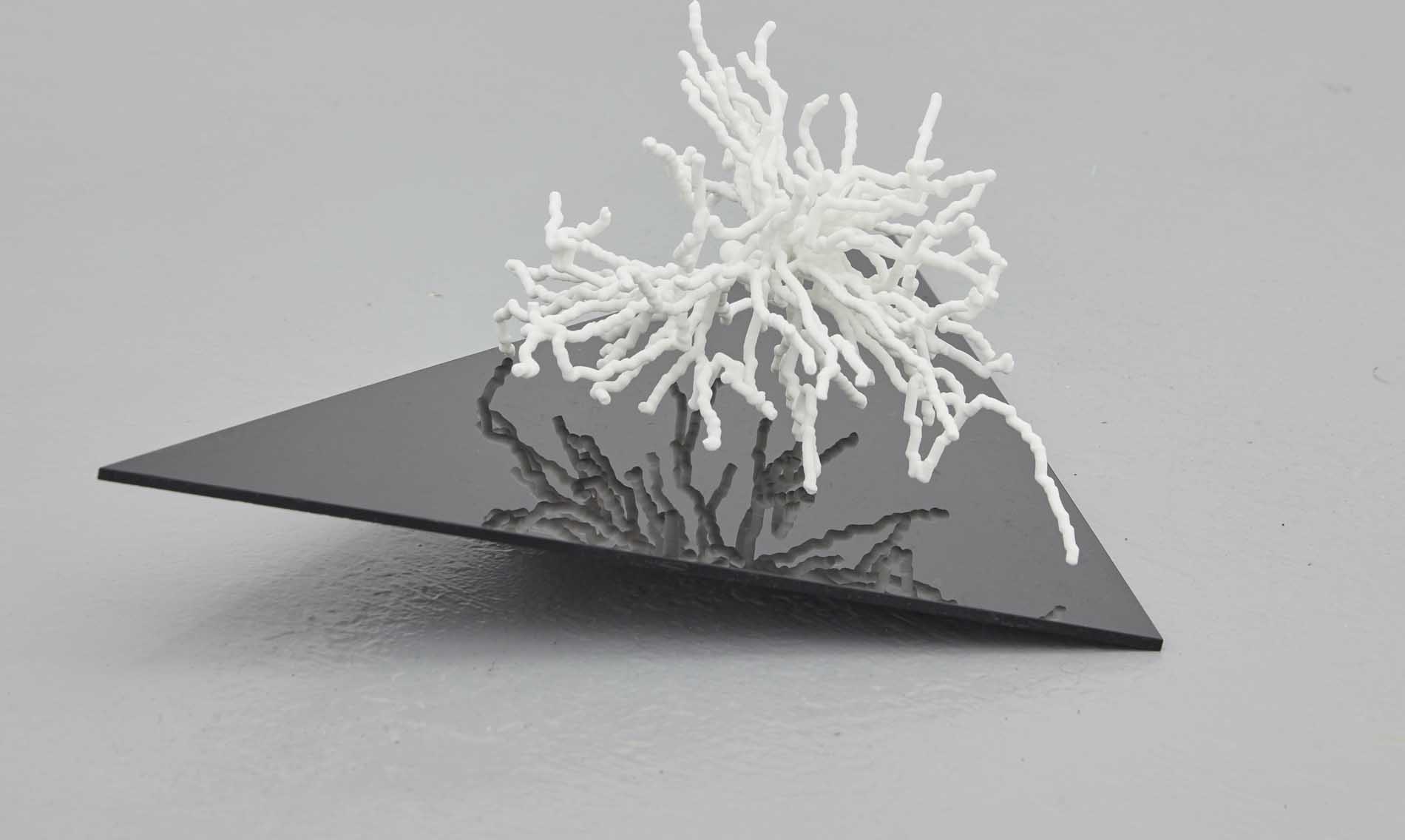
The installation is made up of four poles representing four 3D-printed carbonised trees made from recomposed cellulose filaments: an oak, a pine, a fir and a birch. Next to each sculpture is a high stand on which rests a touch-sensitive tablet that transmits an image corresponding to its tree and was generated using photogrammetry, a 3D modelling technique used to measure and reconstruct a scene. These trees contain digital information, including their GPS coordinates, and can only be revealed by the tablets. The public is then invited to activate the tablets, which interact with each other using collaborative augmented reality, a tool that enables virtual elements calculated by a computer programme to be superimposed on an image, and data to be influenced from one tablet to another. When one of the tablets is activated, in no particular order, a soap bubble appears which eventually falls and crystallises in the floor if another tablet in the room is not active. This encourages visitors to interact with the work and with the other participants, to move around it and synchronise to keep it alive. In the same way that mycorrhizae exchange nutrients, the public takes on this role to communicate information about the trees via the tablets.

The cloud analogy is also present; Pyrocumulus refers not only to smoke, but also to the internet cloud, another artificial cloud that contains data, creates real carbon dioxide and therefore has a considerable impact on the environment. To describe her installation, Alizée talks of molecular aesthetics in reference to Eugene Thacker, as opposed to biomimicry, which she considers solutionist, or the 'wood wide web' that is increasingly used to compare computer network systems with plants. As a result, her work is presented at Accès Cultures Électroniques in 2022 as part of the group exhibition “Design des signes, de l'œuvre à l’usage” alongside Hervé Fischer and Grégory Chatonsky. Pyrocumulus is then showcased at ISEA in 2023, but for Alizée it is above all the beginning of a reflection linked to the deconstruction of a human vision imposed on the non-human world. The project is also part of a wider research project looking at the impact of the anthropocentric vision applied to living things.

Pyrocumulus does not seek to respond to a problem, or even to reproduce reality; on the contrary, it invites us to experience plant expression.

Yet Alizée Armet strikes a sensitive chord and tackles very real issues by choosing the path of the imagination and empathy.

Collaborations

Isabelle Lazcano - Graphic Design
Jean-Jacques Gay - Accès Cultures Electroniques
Patxi Bérard - ESTIA
Denis Geral - ESTIA
Le Second Jeudi
Centre National de la Propriété Forestière - CNPF