When it comes to projecting a possible future through a work of art, there is a common misconception, outside the cultural milieu, that the proposed project must have a very real end in the present. Yet the very essence of the artistic approach is that it is not solutionist, and if it is, it is only through the narrative in which the project is embedded. Alizée Armet belongs to the group of artists who experiment with possible future solutions to a current problem, without providing any utility for her installations other than that of the imagination. Her favourite theme is the more-than-human, in particular the relationship between natural elements and the human influence on them, a subject she tackles through the use of BioMedia.
Alizée Armet
01.12.23
"I often say that I create speculative machines rather than installations, because I reflect on a possible future while at the same time echoing the present."
As the daughter of a military officer, Alizée has an eventful childhood. Her father's work requires the family to move frequently, and she spends time in various regions of France, often remote, and in Europe. These experiences play an important role in shaping her future. The period during which they lives on the island of Réunion was paradoxical for her; it is a moment during which she spends time in the "jungle" and receives her first computer at the same time, a coexistence between these activities that seems antagonistic at the time, but elements of which can be found even in her future works. Finally, another event leaves its mark on her: while her family is visiting Dubrovnik, she remembers the bullet marks on the city's walls. Alizée already knows that she wants to pursue a career that will enable her to raise awareness of the issues that affect her. But she suffers from dyslexia and dysorthographia, which encourages her to choose art as a means of expression.
After a classic educational path, she joins the Ecole Supérieure d’art des Rocailles in Biarritz and then does her master's at the Ecole Supérieure de l’Agglomération of Annecy. During her studies, Alizée begins to deal with conceptual reflections on nature and culture, but doesn't want to limit herself to representational subjects. She feels that she has difficulty in finding the right materials to convey her ideas, or even in forging her concepts, and feels that her works are too naïve. But in 2013, during an internship at the Fonderie Darling in Montreal, things change; there, she discovers inspiring young artists, and the use of the internet as both a medium and an artistic challenge, or more broadly, the digital arts. Over the next three years, she turns more confidently towards subjects linked to technological developments and the impact of the industrial revolution, but still doesn't feel sufficiently equipped to follow through with her ideas.
She then pursues a PhD at the University of the Basque Country in Leioa, Spain, from 2017 to 2021, with her dissertation topic "Art and Technology in the 21st Century. From vision machines to artificial intelligence". This environment enables her to deepen the technical part of her work, to create her own hybrid language between art and industry, and above all to integrate BioMedias as an artistic medium. She finds a new balance in her practice, between rigour and creativity, and a way of incorporating the notion of technological innovation into her artistic concepts. Plants are now taking centre stage, not just as aesthetic objects but as the main players in her creations.

For Alizée, it is also the beginning of her collaborations with the scientific community. As part of her thesis, she takes part in an inter-exchange residency in Frankfurt, where she co-creates with two INRIA doctoral students a neurofeedback installation (a method based on the brain's neuronal activity that enables the subject to learn how to control it) that activates the data collected in a virtual reality environment. While the experience desensitises her to scientific issues, it also raises a certain mistrust among researchers about her status as an artist. This stems from a fear of the appropriation of information and the misuse of its meaning for aesthetic purposes. In her opinion, this is a systemic problem; scientists are steeped in their protocols and are not given enough opportunities to explore outside their comfort zone, which creates this distance from art.
For the #MAHAIA2020 project, she collaborates with four artists and ESTIA engineer Patxi Bérard on a collaborative augmented reality installation. Their mission is to digitally connect pieces of a work representing a table created by Yves Chaudouët. Alizée finds it difficult to work in this type of collective, but builds a professional friendship with the engineer who accompanies her on the technical part of other projects and later, Pyrocumulus. In fact, it is the first project she has produces after her thesis, and for Alizée it represents the culmination of the concepts she developed during her thesis. She brings together art, design, science and engineering, and refers to the Speculative Everything (A. Dunne, F. Raby) modes of thinking, which provide an opening onto the future while evoking an existing and current context. She presents her work at the "Digital Ecologies in practice" conference at the University of Bonn in 2022, where she feels like a fish in water. Surrounded by artists, engineers and researchers keen to share information and collaborate, they talk about tackling ecological and societal issues while integrating technological innovations.

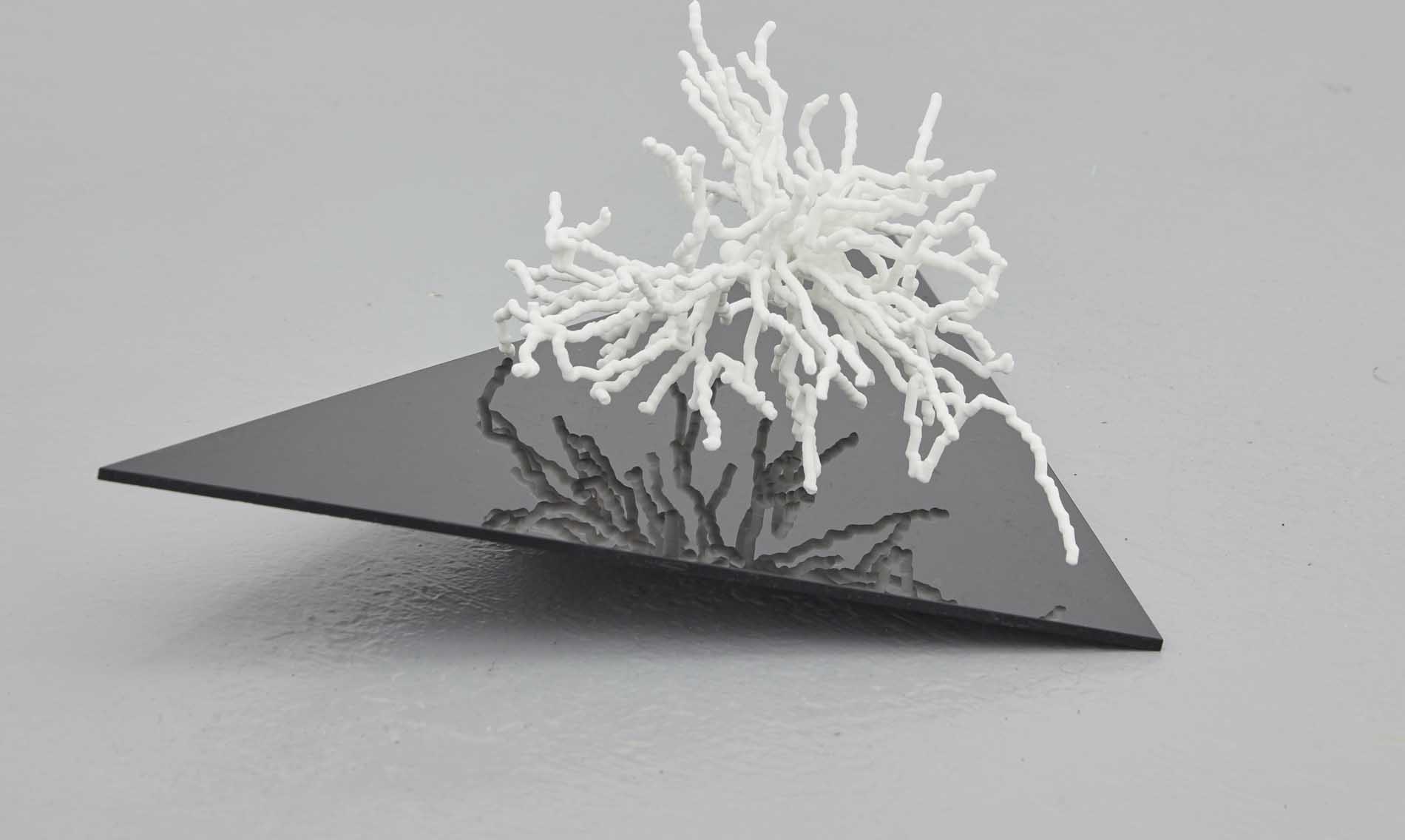
Alizée continues in the same vein with Gosthly plants of damaged worlds, an installation based around albino plants that can no longer produce photosynthesis. It's another reflection on the human impact on their natural environment and the relationship between plants, an obvious conceptual continuation of Pyrocumulus, which is part of a wider artistic research. This new project, funded by an EMAP residency, which she will be exhibiting at Ars Electronica and Da Fest in Sofia in 2023, gives her international exposure. It is currently part of the group exhibition "I Told You It's Alive" at the Kapelica gallery in Ljubljana until February 2024.
In parallel, she runs the "ptit-bugs" project; she designs and facilitates creative workshops for children in day nurseries and multimedia libraries, in which she teaches them to use different technologies with the aim of awakening their creative senses, but above all making them aware of these uses and the consumerism associated with them. For the time being, she continues to work simultaneously on these educational and artistic projects, but she wants to go further. Recently, she has taken an interest in the notion of autopoiesis, theorised by F. Varela and H. Maturana in 1972, which refers to the capacity of a system to self-produce by maintaining its structure despite the modification of its components and information that occurs through continual interaction with its environment. This notion goes hand in hand with the question of technological integration, in particular machine learning, in living organisms, which she would like to explore in greater depth at an artistic level. Rather than limiting her work to the generation of images and information, Alizée believes there is an urgent need to explore the use of AI in cellular biology, just as with xenobots. However, she has no plans to undertake such a project without national or international scientific cooperation, which could be an opportunity for her to reconnect with her beloved Canada.

Alizée Armet has chosen to talk about nature by questioning the way we operate as a Western society.
Through her research, she activates an engaged dialogue between biology and technology, while stimulating critical reflection and imagination.
Artist
Project
Related Projects and Articles

Pyrocumulus / Behind-The-Scenes
Pyrocumulus is a collaborative augmented reality installation that explores the modes of communication between trees following a mega fire.Read more