The excesses of Artificial Intelligence and digital surveillance have long been romanticised, subject of the most famous dystopian works of science fiction, as a warning of what our society could be in for. Today, there is no longer any doubt. We have well and truly turned a corner, so much so that regulating the use of algorithms in professional recruitment will be on the agenda for the next European elections in June 2024. In practical terms, this means that the systems have already been developed and put in place by public institutions. Given these circumstances, it is no longer a question of establishing the limits of what an AI can achieve or how, but rather of knowing what we are prepared to accept individually and collectively. What will tomorrow's norm be? This is a question that artist Sanela Jahić has been asking herself for some time. Her project Under the Calculative Gaze shows how algorithmic systems contribute to widening existing social gaps and represent a danger to our civil rights and individual freedoms. Somewhere between sociology, art and activism, Sanela tells us very real stories.
Under The Calculative Gaze
For the artist, this is nothing new; the application of AI in various public spheres and its impact are battle horses. As she continues her research, one day in 2020, she receives an e-mail from a young researcher who develops an algorithm that is supposed to assist the unemployed, for an institute as part of an European project that deals with the labour market.
Only it actually won’t ; it will just predict who might get a job sooner and rank the candidates. But the problems associated with unemployment are multiple and complex, and require social restructuring. So when public and private institutions entrust the power to decide on the future of human beings to a machine, in reality they are absolving themselves of any responsibility.
These systems may be created by the government or by companies, but generally, the public and private sectors work hand in hand. The political authorities agree on the measures to be put in place, often with the underlying idea of ensuring the safety of citizens, and determine what they consider to represent a threat. Companies, on the other hand, provide consultancy and expertise. But the way they operate and the criteria they apply are not clear, which makes the task of identifying injustice more difficult. What is certain, however, is that minorities and marginalised groups are very often the unwitting guinea pigs of these systems. Political science researcher Virginia Eubanks is no stranger to these practices; in a 2014 article she was already describing and alerting us to the dangers of their normalisation for populations considered 'at risk' by the American state. Her interviewee at the time, a young mother on welfare, warned "...you should pay attention to what happens to us. You're next."

These issues are of great concern to Sanela; she is deeply opposed to the idea of building a system that reinforces existing power dynamics and deepens societal gaps based on exclusionary values and attribution criteria that originates from an ideology. Shaken in her convictions, she decides to start her project. In 2021, she is approached by Aksioma - Institute of Contemporary Art in Ljubljana, with whom she has collaborated in the past, and presents them with her project. They are going to support the research and production via konS ≡ Platform for Contemporary Investigative Art, a funding platform created on the initiative of independent Slovenian cultural organisations, dedicated to artistic research and interdisciplinary creation. The collaboration with Aksioma is as fluid as usual, the artist feels encouraged and supported throughout the process, and feels grateful to their team.
She first contacts Dan McQuillan, whose article Mental Health and Artificial Intelligence: Losing your voice strikes the exact right chord. At the time, the expert in creative and social computing is writing Resisting AI, but still takes the time to respond to Sanela. He agrees to collaborate on a video that will be part of the final art installation. She flies to London to record Dan and spontaneously makes contact with 56a infoshop, a DIY social centre that she considers to be a space of resistance and of which she makes 3D scans of. She later will be in touch with Extinction Rebellion as well, who will give her permission to use some of their video contents for her project.

The artist then sets her sights on communities active in the fight against injustice in the workplace. She comes across a unionised Amazon warehouse worker based in Chicago whom she contacts, not as an artist, but as a creative industry worker facing difficulties in her country. He shares with her his experiences of collective organising, his own difficulties, but also the need to synchronise trade union movements around the world. Sanela is inspired; beyond laws, social measures, geographical and cultural differences, all these people, all over the world, have in common that they are fighting for better working conditions. She re-reads his interview a dozen times, feeling the power behind his ideas and words that reinforce her own beliefs, not just in this battle, but in the ability to change her own situation.
When she looks for similar actions in other countries, she finds Magda Malinowska, who was illegally fired by Amazon for speaking out about a coworker’s death due to poor working conditions. Being part of the Polish trade union Inicjatywa Pracownicza, she took a stand by taking the case further to the court, and encouraging workers to assert their rights. It's not the company itself that interests Sanela - Amazon is a coincidence - but rather what the basic principles of such an organisation are, and how to restore workers' confidence and belief in a better future. So the artist, attentive, films the testimonies of experiences and stories; the way in which the workers are separated, the control of their conversation time, their break time and their location in the warehouse, the slide towards automation of the body but also and above all their actions of resistance.

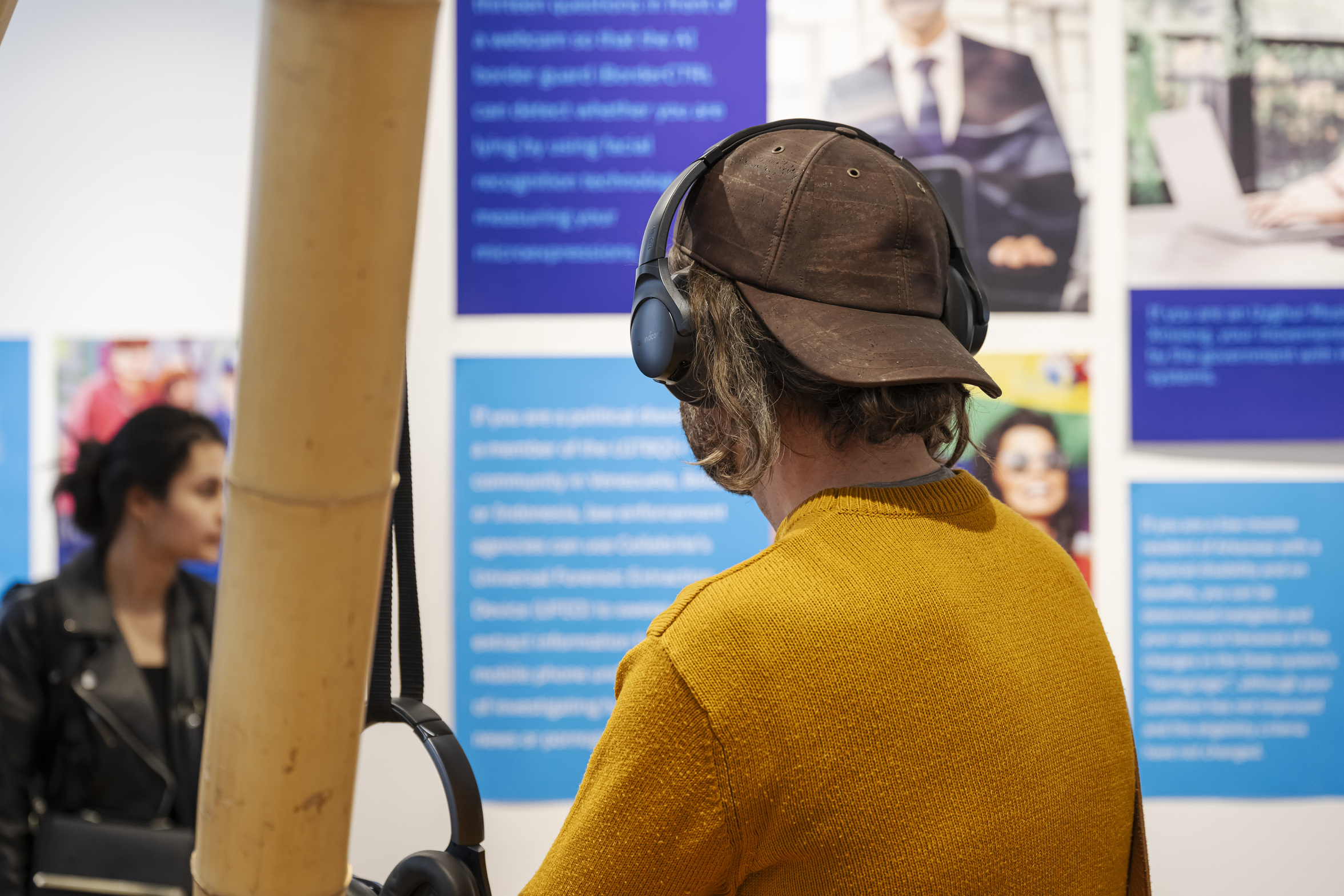
In 2023, the installation takes the form of several videos, a series of posters and hammock-like structures. The video No to AI, Yes to a Non-fascist Apparatus alternates between extracts from Extinction Rebellion during a demonstration on an Amazon site during Black Friday and photogrammetries of places where resistance is being organised. Photogrammetry is a technique for measuring an object or scene using photographs taken from several points of view, resembling a 3D scan. Here, there are imperfections, intended by Sanela to counter the illusion of perfection generated by the machine. The video is narrated by Dan McQuillan, who wrote the text specifically for the work, and describes the fascist tendencies of AI. The other videos feature interviews the artist conducted and footage collected inside various Amazon warehouses by union workers who secretly filmed their workplaces prior to the project. She also creates a highly systematised and informational environment with a series of posters entitled, 1s and 0s, haves and have-nots, created using the Carbon Design System, an open source product design platform launched by IBM. These refer to a classic marketing model: a stock image of a satisfied, smiling customer, accompanied by a text describing their experience. Here, Sanela uses these codes, but shatters the illusion by featuring a short description of a concrete example of how and where the application of probabilistic algorithms has led to discriminatory and harmful practices. Although the artist has collected over 200 examples, her selection is designed to enable the public to identify with them, so she diversifies the social, professional and geographical contexts, physical appearance, gender, etc., making the system the common denominator for all visitors.

Lastly, the structures on display in the installation are based on the design of the bamboo protest towers used by Extinction Rebellion during their demonstrations; they are tensegrity structures, a self supported structure made up of isolated components within a network of chords that are under continuous tension. Made from very light materials, they are easy to transport, and are quick and simple to assemble. They can be used to block entrances or to take refuge high up during police raids on intervention sites. In Sanela's installation, they allow the public to connect with the other pieces by taking a seat on it, while counterbalancing the omnipresence of digital technology.
When she receives an invitation to exhibit her work at Art Meets Radical Openness, Sanela doesn't hesitate. The event is dedicated to resisting the economic, social and ideological monopoly of the digital industry giants, by creating spaces for artistic expression, sharing and learning, in a spirit of benevolence. This year's theme, Dancing at the Crossroads, invites us to imagine alternatives for a desirable future where technological decolonisation, civic resilience and the defence of nature are on the agenda. The project can be seen between 8th and 11th of May 2024 at the MAERZ gallery in Linz.

Science fiction writers portrayed futuristic societies already firmly established in technological dictatorship, but gave us little indication of the path towards it. Engaged artists such as Sanela Jahić show us a concrete way forward and warn us against the gradual political shift.
Under the Calculative Gaze highlights, on one hand, the indiscreet way in which AI looks at our lives and how we are exposed to it, and on the other hand, the potential change in our behaviour to meet the future new norm that it will end up imposing on us. But let's not forget to trust in our ability to organise ourselves collectively and take action against injustice.
Technical director : Andrej Primožič
Author of the essay : ‘No to AI, Yes to a Non-fascist Apparatus’: Dan McQuillan
Visual image and graphic design : Jaka Neon
3D animation : Toni Mlakar
Audio post-production : Julij Zornik
Image post-production : Art Rebel 9
Production: Aksioma - Institute for Contemporary Art / konS ≡ Platform for Contemporary Investigative Art
Related Projects and Articles
Sanela Jahić / Portraits