The preconceived idea that artists work cloistered in their studios still has a firm hold on the general public. Yet collaborative practices are widespread in the field, with or without interdisciplinarity. Many artists draw their inspiration from dialogue with communities of individuals, which involves building relationships of trust and research based on endurance. The work of art then becomes a powerful message carried by a collective testimony. Sanela Jahić places the individual and the community at the centre of her practice; with her own story as a starting point, she gives us a glimpse into that of others.
Sanela Jahić
05.05.24
“I reach out because I want to learn, I want to see other perspectives, I want to include other stories. The collaborative process has been very close to my heart. It allows me to connect with people, to get to know and enter different working environments, to incorporate knowledge from other fields of work, to experience the interplay and fusion of disciplines and how they can challenge each other. [...] I get my motivation from this.”
Born in Slovenia, Sanela grows up in a double culture. Her parents are working class and Muslim, and they come from a small town in Bosnia that they left behind. She remembers feeling perceived differently as a child, particularly in the school system. At primary school, she gets good grades and already notices the difference in tone of the teachers between pupils with good and bad grades. Since good grades are synonymous with success, she surprises everyone when she decides to study art later on, perhaps in a spirit of rebellion. However, the academy is the first place where she starts to tie in with her origins. She is surrounded by people from all over with different backgrounds and understands that these backgrounds bring about various personal experiences. They give shape to our ideas, and clues to how we function and what interests us. And what provokes Sanela are the injustices resulting from power dynamics.
She studies painting at first, but then begins to question the very notion of painting and its limitations. She then builds machines, and soon integrates technology into her work. She collaborates with specialists in programming and electronics, is interested in automation, but also opens conversations with people about their work, only to realise that these discussions are as important as the work itself. She wants to highlight these points of view in her work. She seeks out information about workplaces, how technology is used, and how workers are treated. Sanela uses her art to connect with others and unveil their stories. This is the driving force behind her motivation.

Photo credit : Tanja Kanazir – Drugo more
Moreover, she is no stranger to working-class life, not only because of her family background, but also because of her regular summer jobs. And some of her experiences there stay with her; while working in a factory in the textile industry, she has to place the threads in a machine that runs continuously. It is difficult to synchronise all the components with the machine and sometimes the fragility of certain threads jeopardises its smooth operation, and the machine stops. Sanela remembers the stress, so much so that she dreams about it at night. We're all familiar with this feeling. So, to put an end to the nightmare, she develops a strategy and stops taking breaks. But it's not the stress that she takes away from this experience; it's the workers who leave their machines to help her, and then the conversation with this colleague: if the management realises that a young student is capable of working as fast as the workers who have been here for several years, they'll raise the standard of work for everyone. It's in the collective interest to take breaks and stop focusing on the machine.
Sanela collects many of these stories over time, and not only incorporates them into her art, but also learns from them. She meets communities of workers as a person, not as an artist, and builds relationships of trust. For her, this is a priority; like a journalist, she invites people to share their stories, seeks out background information to contextualise them, takes a stand, and then thinks about the best way to communicate her message to the public through an installation. Up to this point, her own observations and those of others do not seem very optimistic; from an early age, individuals are projected into a standardised system through inadequate evaluation grids, and their belief in the idea of being able to go beyond this system is shattered, only to restrict the scope for individual thought and autonomy later on in the workplace.

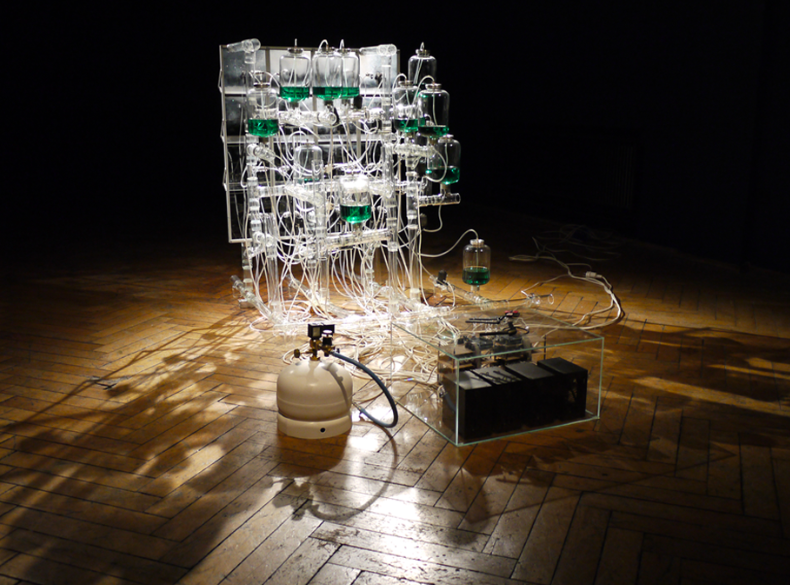
The problem for factory workers is that nobody is irreplaceable. And this is getting worse with the rapid and increasing integration of new technologies into work processes. Under Sanela's critical gaze, the subject increasingly takes centre stage in her works, highlighting the essential need for humanness. In 2018, her project Uncertainty in the Loop denounces the generalisation of automation in the organisation of work, the use of predictive algorithms and their risks, and the gradual elimination of essential human qualities in certain fields, such as creativity or empathy. The systematisation of tasks is 120 years old (or at least the theorisation of Taylorism), and bosses have always modified work standards by pushing workers' physical and psychological capacities in the name of productivity. And what happens when the machine algorithm is applied to the production of artworks? Sanela explores the machine's capacity to conceive works of art once it has integrated the artist's creative processes. As with Under the Calculative Gaze, here she highlights her concern about the gradual shift towards algorithmically-guided decision-making in relation to workers. She does not hesitate to draw a parallel between the advantage of institutions in positions of power and a legislative framework that is sufficiently imprecise to push workers to create their own legal organisations to protect themselves.

But as at the textile factory, Sanela sees humanity, solidarity and resilience, and seeks to highlight them. She also campaigns for better working conditions, and joins Zasuk (of which she is no longer a part of), a Slovenian organisation for self-employed workers in various industries in the cultural and creative sector. By determining the direction of the organisation and establishing links between the different problems faced by workers, they will be able to support each other better. And they don't hesitate to connect with other unions based in other European countries. The cultural sector has its own specific problems, although they are common to all cultural sectors at a global level: artists are continually paid by visibility, organisations are pitted against each other in the race for public funding, and often it's only at a certain point in our careers that we start to see ourselves as workers, because our passion for the job eventually wears us out. Yet we know all too well that passion and visibility have never paid anyone's bills.
So when it comes to choosing where to show her work, Sanela prefers organisations that she feels are in line with her ethics and values, regardless of their size or reputation, and the same goes for her publications. This year, Under the Calculative Gaze has been exhibited by Drugo More in Croatia, and will be the subject of a solo show as part of the Art Meets Radical Openness festival in Linz (8-11 May 2024), in which the artist will be taking part. The exhibition opens on the evening of 7 May at the MAERZ gallery, and will be on view until 29 May, before moving on to Verona in Italy, at the Fondazione Spazio Vitale.

Photo credit : Katja Goljat & Matjaž Rušt – konS
Sanela Jahić is deeply concerned by the situation of workers, and offers us a vision of the future that awaits us if we don't act now.
But she also takes care to include a great deal of hope in the message of her artworks, a hope that is visceral and resolutely human.
Artist
Project