The posture of art researchers does not differ greatly from that of scientists; artists network, define methodologies and experiment, with the aim of advancing common knowledge in a field. Selma Lepart started out creating art and found in research a way to deepen her insights. She is interested in the autonomy of artworks, their relationship to their environment, and the role of new technologies in this regard.
Selma Lepart
24.06.22
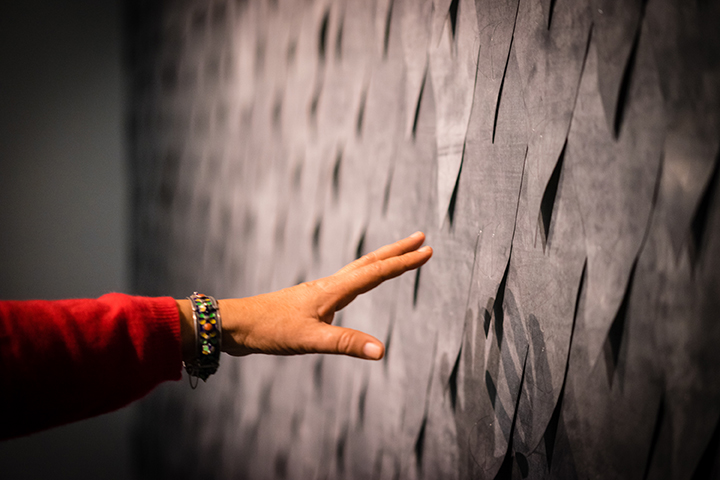
Photo credit : Marielle Rossignol
"Mixing cognitive theory with art practice and philosophical thinking is what interests me. I'm not attracted to making a finished object that works.”
With a research biologist father and a qualified trainer mother, we might have expected Selma's attraction to research, but this aspect does not come until quite late in her artistic career. In her youth, art does not play a major role, unlike swimming, which she practices at a high level. She remembers two distinct details: firstly, that water is a partially controllable element, a material that needs to be in osmosis with it, and secondly, the relationship of trust established between the coach and the swimmer. If one does not advance, neither does the other. In spite of everything, Selma sets her sights on art; she joins the Ecole des Beaux Arts of Nîmes in 2001 for two years, before flying to the Reunion Island where she continues her training at the same school for another year.
The artistic curriculum is fulfilling, she develops her own thought patterns, the experiences are positive, Selma learns a lot, and does not give up on art. She continues for two more years, this time at the Arts Décoratifs of Strasbourg, where she is initiates into craft practices, from glass blowing to engraving, via ceramics. She discovers the transition of materials during the different phases of modelling, and all the limitations that the techniques impose; also glass is untouchable during its transformation, and clay models itself differently under the hands according to its degree of humidity. Echoing swimming, Selma is fascinated by the relationship with the material and by the time she leaves school in 2007, she knows what kind of work she wants to do.

Back in Montpellier, she begins to create her first major work: Mercure Noir. In a tank about a metre high, there is a bottom of ferrofluid, a liquid attracted by magnets. It is made up of iron particles, which are themselves coated with a surfactant that prevents them from sticking together. The whole thing is bathed in a solvent (oil, water, etc.) giving it a petroleum-like texture. When activated with a magnet, the ferrofluid takes on the shape of the magnetic field spikes, and can be moved in space. Selma builds a robotic system armed with magnets connected to 12 sensors that she places under the tank. As the audience approaches, depending on the angle from which they arrive, one of the sensors is triggered, moving the magnet in its direction, and the liquid follows. Except that Selma, who self-taught herself to code for the needs of the installation, writes a correct but slow program. The numerous visitors place themselves in different parts of the tank, and then Mercure Noir only has time to go to the sensors which are activated several times in a row. Not knowing the mechanism, and despite the disturbing aspect of the ferrofluid, some consider themselves to be left out by the work.
Selma observes; the audience is disappointed not to be at the centre of attention. Her expectations and her ability to put herself at the centre of the work leads the artist to ask: how can the perception of a work of art change the behaviour of the person who experiences it?
The interactive dimension then becomes essential in Selma's work. She produces a variety of installations that are quick and easy to set up, and always with materials that have the inherent ability to deform themselves. The larger works require more time and funding, and Selma is caught between her exhibitions, and her work at the "Living Room", a residency that hosts three young Occitan artists per year. During the three years she spends there, she builds up a network, assists the artists in setting up projects, and thrives in collaborative work.

Then in 2016, she creates a second important work. With the installation R.E.D (Réponse Électro-Dermale), she takes her experimentation a step further; covering an entire wall, R.E.D comprises triangular silicon shapes capable of lifting thanks to shape memory wires. Made of a metal alloy, the wire expands or contracts in response to heat. The triangles are programmed to move according to their own fictitious circadian rhythm, and the presence of the audience in the room. Their movement resembles that of a bristling hair. Depending on the number of people and the time of day, R.E.D. does not react in the same way; the interaction is real, but it is never left to chance. This experience prompts Selma to start researching.
That same year, she joins the Reflective Interaction research group at the ENSAD Lab in Paris, one of the only ones working on the subject that interests her. But to get in, she has to pass the PhD exam, for which she is competing with fifty other people. She wins her place in the group and it is there, during the open days of the laboratories, that she meets Nathalie Guimbretière, her future collaborator and friend. Far from her living and working environment in Montpellier, she perseveres in the pursuit of her studies and her thesis at SACRe between 2017 and 2019. Nevertheless, she travels back and forth between the two cities every week; Selma's father is diagnosed with Charcot's disease, a neurodegenerative disease that affects motor skills, phonation and swallowing. His life expectancy is drastically reduced, so Selma leaves Paris and ENSAD Lab for good.

However, she continues her research, this time at the Laboratoire d'Anthropologie de la vie, whose objective is to study all facets of the conception of life, even artificial life. Her work is more academic, she no longer develops projects for her thesis, but rather draws up an inventory of what the autonomy of artworks represents, or their capacity to become autonomous. Slightly different from her personal work, her thesis focuses on the projects of other artists or creators and addresses complex issues related to embodied cognition or motivation. In addition, she finds a reassuring coach/swimmer relationship with her new director, and a collaborative environment.
As part of her thesis, Selma discovers Soft robotics and realises that Mercure Noir and R.E.D are based on the same principles. The works interact with their environment and lead individuals to engage in this interaction. As a paradox, Soft robotics is also developed for the needs of people with motor disabilities. Selma wants to further these studies, so every time Nathalie comes to Montpellier, they discuss the possibility of implementing their future LowSoRo project, until the day the proposal for the IMT Atlantique workshop comes through. Today, the artists are looking to develop and iterate the workshops, and continue their journey in parallel.
In May 2022, Selma is working on a film with Vincent Ducarne, of which she is the author. The initial script was co-written with Michael Verger for the ENS seminar Without computer : anthropocene and digital imaginaries in 2019. The fiction features the investigation of the loss of an artificial intelligence, through the interrogation of the scientist who created it. This work, although still in production, could be the subject of an exhibition in the near future, and even illustrate her thesis defense.

Selma Lepart has embarked on the impossible quest to create an autonomous work of art, and all the events in her life so far seem to converge in this direction.
With strength and determination, she listened to her instincts and made the most of each experience to contribute to the common artistic knowledge.
Artist
Project