Unlike its neighbouring cities, Rotterdam is not known for its iconic traditional buildings and its landscapes did not inspire the painters of the Dutch Golden Age. Yet its port is the largest in Europe, known for its architectural monuments, industrial complexes, modern infrastructure, but also for a rich cultural diversity that has earned it the title of "gateway to the world". The pier pressure project comes to life in the waters of the port of Rotterdam. Starting from an interest in marine worms, Mark IJzerman confronts the natural ecosystem with the one built by man. The project explores the notion of invasion in an installation steeped in ecology, marine biology and the city's cultural heritage.
pier pressure
10.02.23
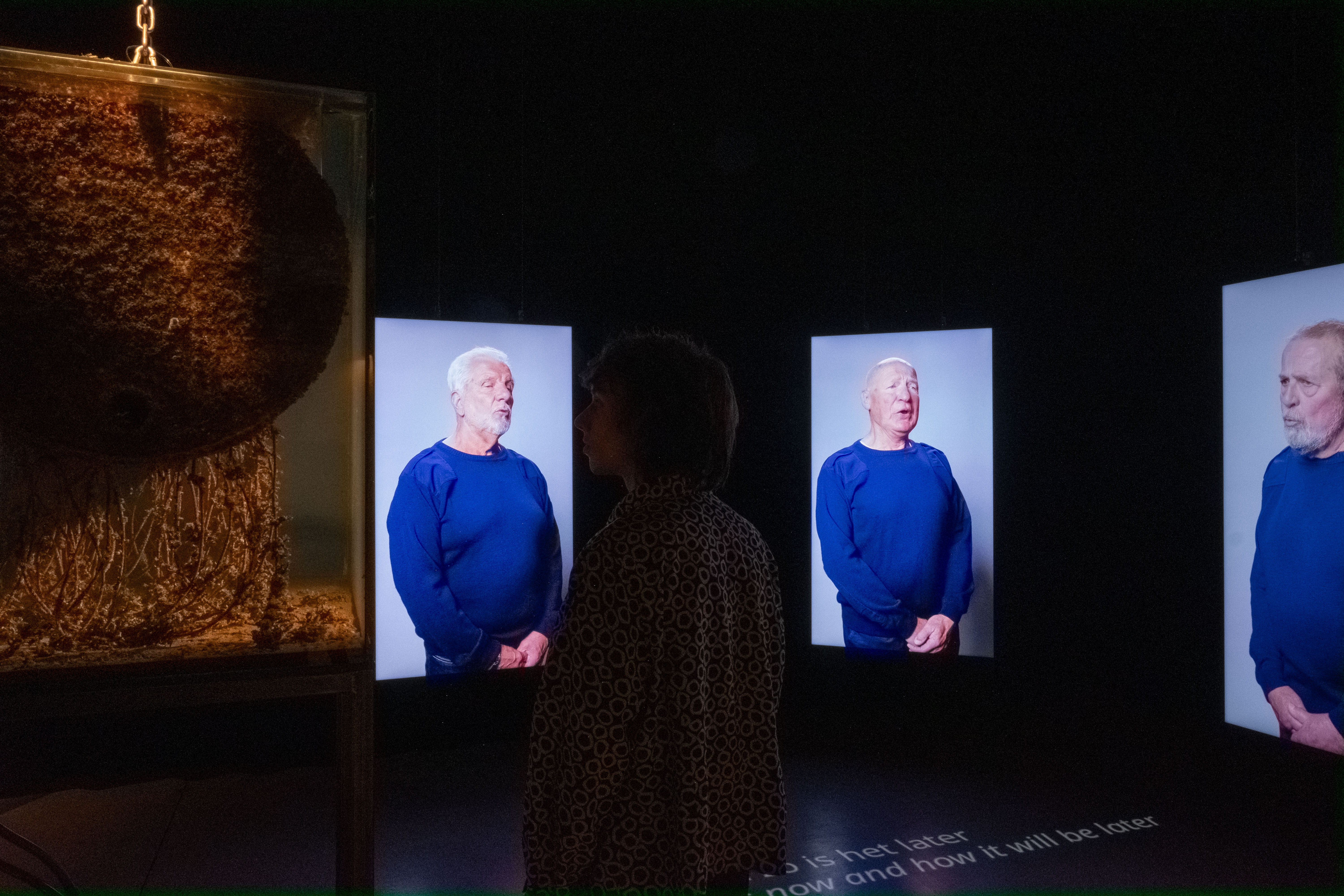
Photo credit : Sébastien Robert
Mark's journey begins with the discovery of Australian tubeworms in the canals of Amsterdam, where he is based. During the pandemic, he wanders around the city with local ecologists who tell him that one of the major impacts of the climate crisis is the appearance of these worms, never seen here before. Indeed, with the flourishing international maritime traffic, species from elsewhere are landing in Dutch waters, and the rise in water temperature encourages them to settle. Intrigued by these mysterious creatures - Ficopotamus Enigmaticus - which most people don’t know what they look like, Mark decides to meet them. These worms are considered an invasive species; living in colonies, they secrete a calcareous tube around themselves, and develop networks of tubes that can sometimes be several metres long. They act as filters, feeding on plankton or detritus particles in the water.
Determined to work with them in some way, Mark takes these objects and places them in an aquarium in his studio to better observe and understand them. At the same time, he responds to a S+T+ARTS4water call for proposals focusing on biodiversity in the port of Rotterdam, whose issues are the sustainable interaction between humans and marine life; how to address the entanglement between economic growth and biodiversity? And how does this influence the culture of the port? The artist wins the call and knows that he will have to be ambitious. This is the beginning of a year-long residency that will be punctuated by 3 events showing the work in progress the aim of which is to get into a conversation with the audience, and allow them to observe the experiments as well as gather their feedback.

photo credit : Adriaan van de Polder
Except that he doesn't know if he'll find this species in the waters of Rotterdam, and the first time he looks, he doesn't find it. In fact, he doesn't know where to look. So he writes to a number of specialists in the field for help. But he soon realises that most of them are publishing research without even leaving their offices or seeing the animals with their own eyes. Wanting to work with someone who knows the field, he approaches the port authority who puts him in touch with Peter Paalvast, an independent ecological consultant. Passionate and open-minded, his work involves taking a critical look at the impact of port activities on the ecosystem, which makes him the ideal partner for this project. With him, Mark learns about the different methods of regenerating the marine environment and the consequences that go with it. One of them is to put boards, wires or concrete structures in the water to monitor the proliferation of different species, but also to allow fish to grow and ensure the health of the waters.
Peter takes the artist to the same places he visited two weeks earlier, but shows him the right way to find the coveted worms. Mark does not study the worm itself, but rather relies on the scientific research already carried out. Together with Han Meyer from Deltastad, he also looks at the town planning and future of the port of Rotterdam; originally the area was an estuary with wide banks and shallow rivers, but the building of the city and the needs of trade led to the construction of an artificial peninsula on which most of the port rests. Expanded over time, it now presents a high risk of flooding, and the municipality plans to recreate a landscape similar to the original, while adapting to contemporary issues, since the port infrastructure is still needed. So, it's about finding the fine balance between what we create and what was already there.

Photo credit : Fenna de Jong
Mark calls his project pier pressure, a pun based on the double meaning of the word "pier" which means both "pier" and "peer". He alludes to the friction between the pressure to limit fossil fuels by reducing maritime trade and the social pressure to be a modern human being (e.g. owning an iPhone), which has a direct impact on the environment.
Considering the fact that there's a growing amount of artworks about ecology which are mainly digital in nature (films, VR-experiences, 3D worlds), Mark decides early on that the 'encounter' with this species should be a real one. This however brings a multitude of ethical issues, the hermetic nature and colonial history of aquariums being the most pressing. After discussions with a professor of animal ethics from the University of Utrecht, he carefully decides to go ahead with it, as in this case he considers the ability to create proximity to this other-than-human being to outweigh the downsides. His first exhibition takes place in the premises of V2_, the project's cultural partner, where he shows timelapses of the harbour, tube worms in a small aquarium and plays songs on audio. In his second exhibition, he displays the documents that explain his approach and research into the state of the harbour and marine species, and displays a clean barrel adorned with wires which will be immersed, allowing marine creatures to colonise it. He realises that his speculative vision is mainly based on scientific data, that ecology is very important, but that the human element is missing.
Mark imagines creating a ritual for the moment when the barrel emerges from its immersion. He remembers the sea shanties and invites local choirs to collaborate. When he gets a positive response, he goes to meet the men; they all worked in the harbour in the 1960s-1970s and remember the water covered in oil slicks and other filth, the harbour before the ecological discourses. Not all members of the choir are open to Mark's project, so those who are passionate about art and ecology decide to participate. The song selected for the final installation is about how the port of Rotterdam is and will always be the same, which is in direct contradiction to the barrel. The artist films and records them and projects them onto three screens during the exhibitions, the sound of which is activated as the viewer approaches. However, the third exhibition takes the form of a performance as Mark invites the 40 members of the choir to come and sing live for 2.5 hours.

photo credit : David Danos
Finally, to celebrate the end of the residency in a final event, the work is exhibited at V2_; the choir is present only on the screens and a Shell oil drum is now invaded by marine life. His aim is to open up a conversation about the future of the port of Rotterdam and the colonised barrel is his artistic act, meant to give a glimpse of what marine life in the port might look like in 30 years' time. He also gives a talk about his work at the Guggenheim in October 2022, and plans an event at the Maritime Museum in Rotterdam in 2023 where the installation and the choir will possibly return. But a project with social and ecological utility should not end after a few exhibitions; after taking the subject into the academic and research field, it is clear that these regeneration methods could be applied to many other species and environments. The artist has the idea of soliciting, in the near future, companies that deal with underwater datacenters, to make them development structures for marine animals.
In the end, Mark will have worked with an environmentalist, collaborated with local businesses to collect the material and design the immersion mechanism, convinced a choir, and brought the people of Rotterdam together on a subject that concerns them, all in partnership with cultural institutions. He will have positioned the public between different domains linked to the same context, and confronted the frictions between human and marine life. Above all, the artist will have created a unique framework that will have allowed people who, at first sight, have only their city in common, to meet and exchange. This new aspect of his work, which he discovered through the development of pier pressure, he wishes to continue exploring in the future.
Pier pressure proved to be a bridge between the past, present and future of the port of Rotterdam and its human and non-human inhabitants.
More than just an art project, Mark IJzerman's work has opened up a social dialogue necessary to build a better common future.
Artist
Collaborations
V2_
Peter Paalvast - Ecoconsult
Han Meijer - Deltastad
Harry ten Hove - Naturalis
Laura Mackenbach
Shantykoor Barend Fox
Sasja Voet
Adriaan van de Polder
Nienke Huitenga
Sam Huisman
Shami Durrani
Rob Emeis - Zorona and Nathan Marcus
Franck Meijboom - Universiteit Utrecht
Maurice de Bruijne
Sjef van Gaalen - Structure & Narrative
Just van der Endt - Witteveen + Bos
Pauline Kamermans & Annemiek Hermans - Wageningen University & Research
Angelina Kozhevnikova
Etienne Abadie - Ecocean
Gijs Bosman - The Weathermakers
Michael Laterveer - BlueLinked
Hans Heupink - Gemeente Rotterdam
Katía Truijen