Our excesses in terms of consumption, whether of resources, images or products, have contributed to the generalisation of a counter-movement and an artistic trend that values sobriety. This does not always mean technophobia, but rather seeking a healthy balance between new and old technologies. Marie Molins is one of those who adopt this approach; by blurring the lines between art and design, she studies and experiments with this fragile balance.
Marie Molins
23.01.23
"Maybe radical art today is about not producing in a world in which we have the opportunity to constantly over-produce."
Originally from Avignon, Marie was destined to pursue literary studies. After only one year of preparatory classes, she opts for an artistic path and enters the Ecole Supérieure d'Art et de Design de Valence. There, she is pushed to choose between art and design, which she will not do as she enrols in art, while continuing to take graphic design courses on the side. Soon enough, she realises that the idea of digital technology is problematic for her for several reasons. The first is due to her computer, her main working tool, which gives up the ghost twice, contributing to the artist's terror of the object. The second is due to the realisation that even computer specialists often don't know what the breakdown is due to, repairing it is almost a matter of luck. Finally, Marie notes that digital objects are treated by those around her, and more broadly by society, as objects of fascination, magical, sacred totems.
While she rejects this form of lobotomisation, she learns code, and seeks to understand how the computer works. When she seeks support from her art teachers, she gets nothing but criticism and ends up turning to the design experts, who are much more familiar with the subject she wants to tackle. She then discovers that she is not the only one who shares an aversion to digital objects, and that the subject has been widely studied. Marie decided that she would pursue her commitment and show how the digital world conditions our behaviour and ways of doing things, through her art. But she poses a new problem: how to translate what we do with the digital, other than through a digital device?

According to one of her mentors, the best way to captivate an audience is to tell them a story. And in a society where culture is marked by the written word, a book can be a powerful tool of persuasion. The artist therefore makes the book, the emblem of knowledge, one of her main mediums. She begins to write scientific and archaeological articles in which she relates false digital discoveries and links them together. By the time she reaches her fifth year of study, she has already collected a series of journals and created a mythology around her stories; her science fictions are a mixture of creating artefacts from the future, talking to fictional experts, and researching real things like working methods. The aim is to be credible enough to be taken seriously by potential readers, and at the same time to blur the boundaries of reality in a subtle way.
Marie's work is comprehensive; she draws and creates organisational diagrams, and crosses her science fiction articles with philosophy. She is particularly interested in Object Oriented Ontology, which removes the human from the centre of the universe and places it on the same level as non-living objects. This perception leads the artist to question her relationship with objects, from their form to their materials. Thus, she steps back from her productions to give them meaning and continuity, but also to reflect on the use of raw materials, which will come a little later in her work. Moreover, Marie, who had already got into the habit of creating teams of fictitious researchers, makes the whole thing more complex by creating alter-egos herself who produced works of art from the pseudo-discoveries. This is how she brings to life a certain Romain Debré; Marie pretends to be an Erasmus student in the studio of this character, whose legitimacy as an artist is already established internationally. Thanks to the well-orchestrated construction of a so-called collaborative project, and no doubt to gender bias, she manages to convince the jury of her school of the veracity of his existence without too many efforts.
Marie continues this study project and expands her collection to about twenty books. She assigns ISBNs to them for credibility, although these refer to images of ham. All that remains is to introduce the works to the public. With the help of the ESAD Valence librarian, she begins with the school library. She then goes to the municipal libraries, then to the Avignon art school, and even to Brussels, where she is invited to exhibit her work. There, she receives an offer to buy from someone who thought she had a real object of knowledge in their hands, and not an art object. Despite some feedback from intrigued librarians, the project is a success.

The entry into the PhD in Arts Research is a new stage for the artist who once again confronts the amateurs of digital technologies. However, this time, it is only to keep the good aspects. Marie adopts another posture and trains herself in reverse engineering; to understand where we are going, we must start by understanding where we come from. She solders, deconstructs materials, looks at low-tech artists such as Benjamin Gaulon or Quentin Destieu, and observes: we are witnessing a profusion of digital artworks, and yet each artist has their own practice, which makes theorising a movement much more complex today and in constant evolution. She formulates the subject of her thesis: why are digital artworks so similar? How do we classify them?
In conversation with the ZKM, whose curators are asking the same question, Marie learns that there is no real protocol, the sorting is done on the basis of technological devices, techniques, performative or interactive aspects. In the course of her research, she discovers an article from the MIT press on computer simulation, and wonders if it is applicable to artworks. So she creates a system in which she defines a precise time and space, and takes the classification data in order to give a fingerprint to each work. After having analysed nearly 200 works, Marie selects 50 with which she demonstrates their similarity through the use of materials and the process of connecting them with the viewer. Beyond the distribution system she has just created, she draws the same conclusion as the philosopher Marshall McLuhan: the medium is the message. Digital artworks use mediums that condition the way we perceive the message, and therefore the final information.
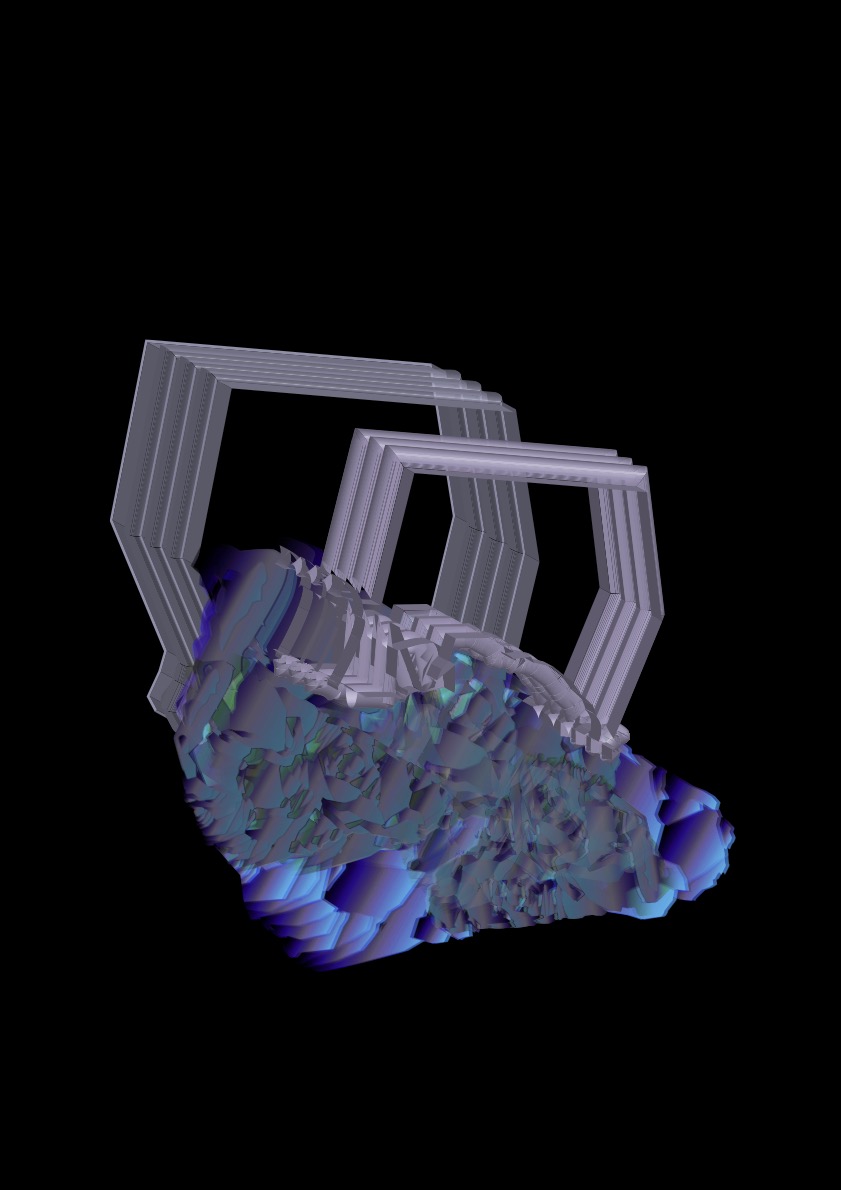
Marie finishes her thesis in 2019, after which she moves to Caen where she teaches graphic design in a school and is in charge of Erasmus partnerships. Although art remains her main focus, she also works as a freelance UI designer, and continues to develop her thesis for a potential publication in a UK publishing house. Her project NO_SCREEN, also in development, is a fine composition that follows the thread of her thoughts and feelings about digital technology through the stages of her journey.

Marie Molins has made a radical choice: not to make any. She likes to mix the codes of design with an artistic approach, to change mediums, to make philosophy evolve, and then to move between fiction and reality.
By making the creative process more complex, she demonstrates that the richness of a work of art lies in its different levels of interpretation.
Artist
Project
NO_SCREEN