Who has never looked up at the stars in the dark and felt very small and wondered "is there anything else in the universe? We have all experienced it at least once, this moment of plenitude. And it is certainly because the question of unknown universes is beyond us, that it fascinates us all; Lior Ben Gai, computer artist, is captivated by the universe of virtuality; "What is out there ?" This is a question that haunts him and to which he may well find answers through his research into the behaviours of the computer programs he creates.
Laboratory of Babel
25.10.21
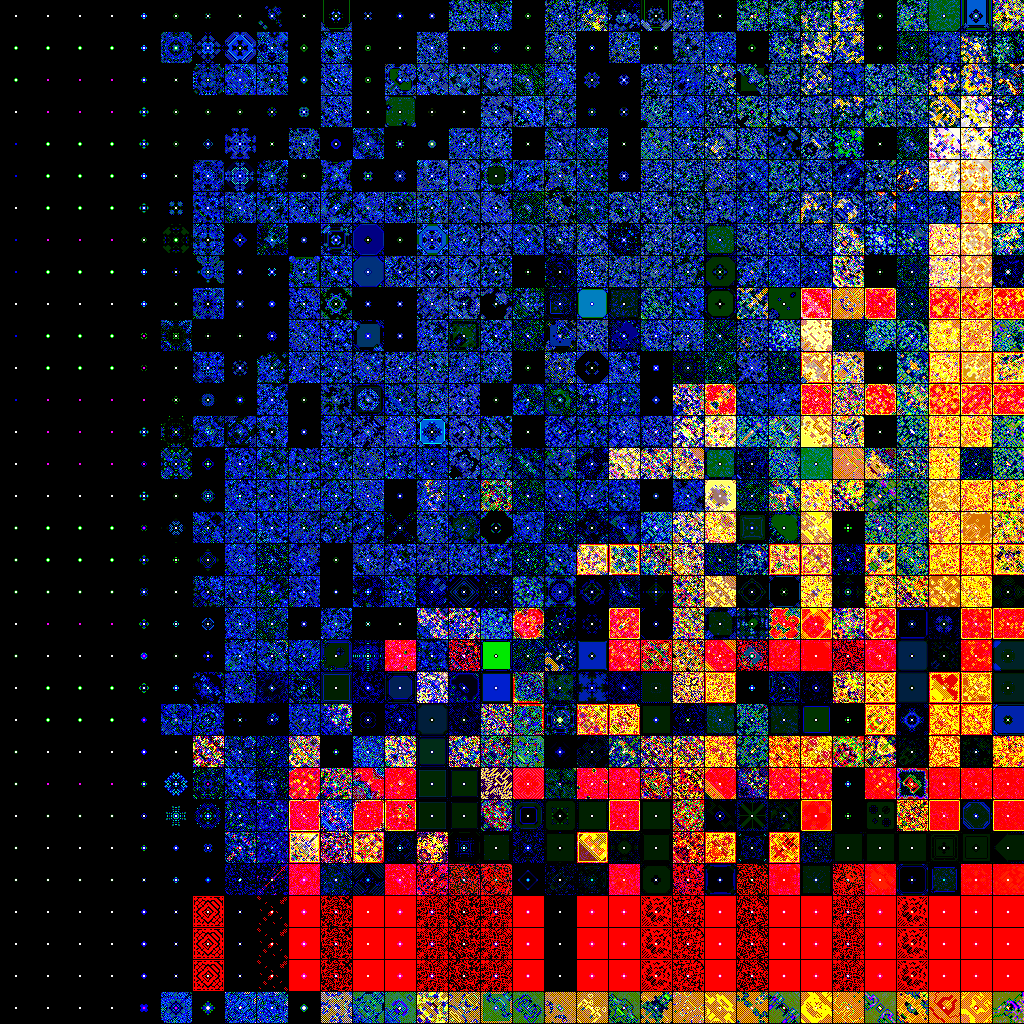
First, we need a computer; a real physical object that we touch, and that will be our portal to this new universe. Once turned on, we enter a virtual world, and write a computer program (or code); it comes in the form of sequences of instructions, like a mathematical equation, and orders the computer what to do. Finally, something visible happens.
The programs Lior is interested in are those of the "cellular automata" family.
They have the particularity of developing complex behaviours, because each cell reacts according to its neighbouring cell, which will react according to its neighbour, etc.. Then we just let them be. The more they multiply, the more they interact, causing them to adopt a classic example of emerging complex behaviour, which is similar to those of schools of fish, or flocks of birds. These behaviours do not come from the code, they emerge from the interactions between cells. In other words, nothing tells them to act the way they do, they end up becoming independent.


If this flocking type of behaviour has been identified before (Craig Reynolds, Boids, 1986), Lior has the intuition that something else is to be discovered. So he designs a new code syntax that will allow him to create more abstract structures and modify the aesthetic aspects of it.
Instead of using computing to simulate those behaviours, he experimented by modifying the parameters to see what happens, and a whole new set of behaviours spontaneously emerged from his experiments. Never seen before, it's an infinite universe of behaviours that is hidden behind the pixels of our screens! From that point, his research began to make sense, and Lior found the motivation to continue designing the tools that allow us to explore these worlds.
His research becomes more complex as he tries to encourage programs to flourish. He even sees himself as a farmer, rather than systematically creating new species of behaviour, he spends his time cultivating existing ones and encouraging them to develop. The more complex the behaviours, the more interesting they become; it is a matter of seeing a group of cells interact with their environment until they evolve into an ecosystem.

During one of his experiments, some cells proved to be temperamental, and only grew when Lior gave them the necessary attention, for example by spending time with his mouse on the screen. On other occasions, he even went so far as to assemble programs, from which a new species of program was born, and so on.
We could easily assimilate them to new natural species; hence the creation of a mini series of playful animal documentaries where we can observe these virtual creatures, evolving in their natural environment, with a background of voice-over.
The fruits of his labor, Lior tries to pass them on in many ways to all those who wish to contribute or create; "utomata" is a program to be used as an exploration tool, for which tutorials will be soon available. But the bulk of his work is the Laboratory of Babel. Directly inspired by Jorge Luis Borges' short story "La biblioteca de Babel", he seeks to create a platform, like a vast virtual bazaar, in which he will list and archive all the existing or future behaviours identified in computer programs.
In the line of Christopher Langton, Lior acts for a more poetic future of science; for him, computation should also be used to explore those emerging behaviours, not only simulation or problem solving. He is rather comfortable with the fact that there are only lines and dots that move around on a screen. This form of detachment gives him the ability to explore all possible behaviours in an infinite space and to study "life as it could be". (C. Langton, Artificial Life, 1989).
In this sense, Lior considers himself as an artist rather than a scientist, because he does not seek to explain these phenomena. Nor does he seek to implement them in a practical way. These structures are in their own right, they exist and evolve in an infinite virtual world.

So, what is out there ?
Thanks to computers, we can both make sense of the world around us, and open the door to a universe of accessible and largely unexplored phenomena. Like others before him, Lior feels that there is something to be discovered and exploited in these computer programs.
There is a parallel universe right here, in our hands, with possibilities to build a different future, and one that Lior intends to be a part of.
Artist
Projects
Related Projects and Articles
Lior Ben-Gai / Portraits
Computing tools are at the roots of Lior Ben Gai’s artistic career, whose professional path has been punctuated by a series of happy accidents.Read more
On artistic exploration as a way of democratising technological tools / Focus
When it comes to research and exploration, artistic and scientific methods converge. Artists have also contributed to the widespread use of technological tools in our daily lives.Read more