There was a time when specialising was not so important, as it was quite common to mix disciplines according to your needs.
For example, Antoni van Leeuwenhoek ; a well-known Amsterdam draper, who wanted to ensure the quality of his fabrics by counting the number of threads in the cloth. In 1668, he created an instrument with a small polished lens that allowed him to see objects up to 300x magnified. Curious, he began to look at everything he could with his microscope and discovered a multitude of tiny animals everywhere, thereby becoming the father of cell biology. In studying these new findings, he made a major discovery that changed the course of history.
On artistic exploration as a way of democratising technological tools
05.11.21
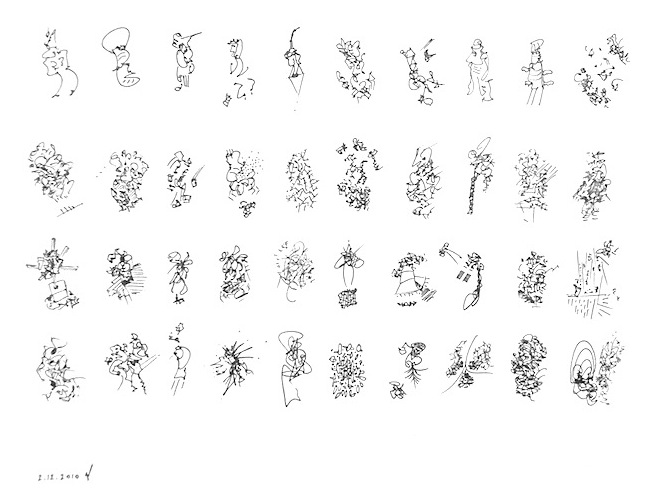
Although less formal, exploration is an important aspect of science; you have to be able to go beyond the scientific limits and listen to your intuition. Lior does not use his computer as a simulation tool, but as a gateway to another universe. And with no complexes, he positions himself between science and art, striving to bridge a gap between the two concepts ; one holds the knowledge and tools while the other seeks to explore unknown territories. If our school education teaches us to separate these approaches, Lior encourages us to unite them.
Often when artists take over the scientific realm, they lead the way in democratising tools; the pioneers of electronic music in the 1960s were engineers. After the Second World War, they were left with high-tech equipment. So if you wanted to create a piece of electronic music, you needed an engineering degree. But if you were curious and enthusiastic like Lior, you didn't need any initial training. Today we can create any music from our computer with software. Lior imagines a similar future for his field; research into complex behavioural systems remains in the hands of scientists for the time being, but thanks to the creation of tools such as utomata, artists will enrich this universe, ultimately giving it the possibility to spread to the rest of the world.

Virtual reality is on the horizon, our screens are bigger, our devices more connected, our digital footprints are growing. We fear artificial intelligence, the superstar of science fiction, moulded in the image of humans and becoming increasingly powerful. However, it operates by solving problems and is used for simulation purposes, unlike Lior's creations. He prefers to project himself into a world where science merges with design and generative art. These practices are similar to his approach which consists of letting programs create artworks on their own, and exploring their alternatives, depending on whether or not they have been pre-recorded.

According to Lior, this is an example of a possible future, as technologies continue to develop. We already spend a part of our reality in virtual spaces, and at the moment it still looks like paper. As the boundaries between these spaces become thinner, virtual reality will take on a different form, and these worlds will need to be populated, thanks to new tools.
So if we still look up to someone like Antoni van Leeuwenhoek today, it is likely that future generations will do the same for Lior Ben Gai.
Artist
Projects
Laboratory of Babel
Utomata