obsolete.studio
En / Fr

Mythology
Heritage
 / Behind-The-Scenes

Frange d'Interferenza

Diane Pricop
13.05.22

When the Pleiades flee mighty Orion
and plunge into the misty deep
and all the gusty winds are raging,
then do not keep your ship on the wine-dark sea
but, as I bid you, remember to work the land.

These words are universal, and resonate to this day as a call to the sources. From north to south, and from east to west, the appearance of the constellation Pleiades in the sky announces the beginning of the ploughing and sowing season. In “Works and Days”, Hesiod clearly and poetically sets out the agricultural and maritime laws, the framework of which can be seen through the stars. But in a world of increasing light pollution, they are less and less visible and the signals are getting blurred. Artist Luca Serasini is working to bring them back to earth; at the crossroads of astronomy, mythology and Land Art, his project Frange d'Interferenza explores the existence of gravitational waves.

It all begins with Luca Serasini's fascination with bulls; at first he simply draws them, red, symbols of virile power, and presents them for the very first time at the M'Arte Biennale in Montegemoli. Familiar with the event, he transforms them into papier-mâché sculptures that seem to emerge from the ground and whose scarlet colour contrasts violently with those of nature. In 2013, Luca's bulls change their faces again: the Progetto Costellazioni project (constellation project) starts to take shape, and land art becomes the artist's main medium.

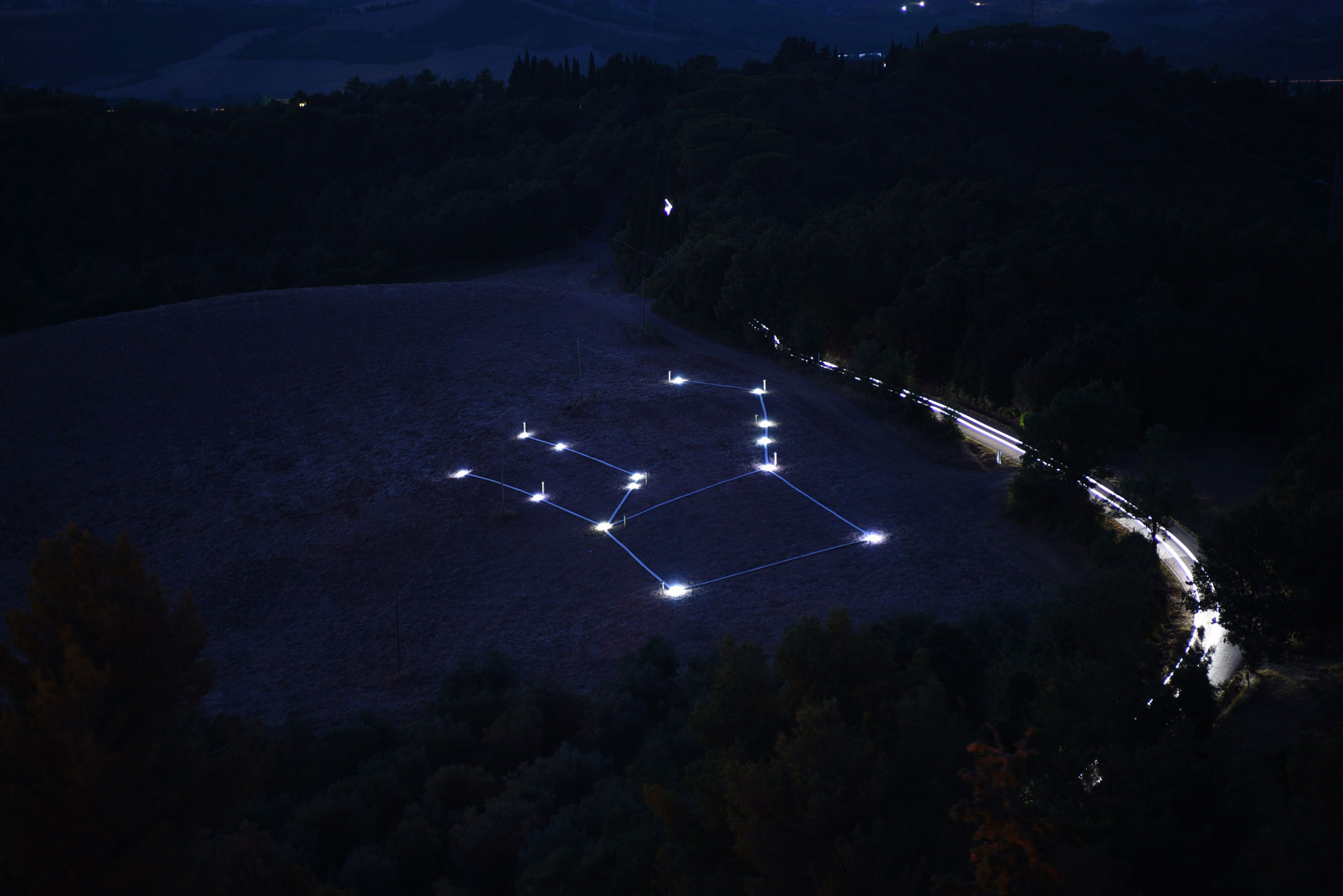
For this edition, he reproduces the constellation of the bull on a blank piece of land: he plants pegs in the ground, each representing a star, and connects them with large pieces of non-woven fabric (a fabric whose fibres are random and whose consolidation is done by chemical treatment). The installation must appear linear from the sky, and function as a mirror for the real constellation. The first obstacle is the hilly terrain, which complicates the placement of the pegs; Luca positions himself as an observer and directs his team to the re-calculated points. The work is about 200 x 80 metres, visible to the general public from the nearby village and the poles, equipped with LEDs, are switched on at nightfall.

He uses the same process for many of his installations, always pushing their interactive aspect further; when he reproduces Orion, it is in a vineyard, the ground is flat and the public can now walk inside the work, between the stars. For this occasion, he collaborates with the musician Massimo Magrini who creates a sound dedicated to each star of the constellation. Using an application that can be downloaded to a smartphone, visitors can enjoy a visual and sound experience.

For Pegasus, made up of ten stars, Luca asks storytellers to create and narrate stories about the characters the star embodies. He sets up ten dial phones, equipped with Arduino, which ring when a person approaches. When they pick up the phone, the star tells them an anecdote, in a choice of three languages. Luca is constantly seeking to establish a symbolic link between the stories, places, and philosophy behind each constellation. His primary interest is in ancient mythologies and he is fascinated by the similarity of these stories from one civilization to another. For him, they bind us as human beings and forge the common History of humankind, it is eternally inscribed in the sky. We have tended to forget this over time, and today more than ever; with the development of urban infrastructures, the multiplication of public lighting, and the intensification of our frenetic lifestyles, the map of the sky is less and less visible to the naked eye.

From 2019, Luca starts to take an interest in the scientific aspect of stars; during a residency in Morocco, he creates an ephemeral work on a sandy beach dedicated to the birth of stars, and in particular binary stars. A phenomenon still debated in astrophysics, they are a system of two stars orbiting around a common centre of gravity. The work, after only a few hours, disappears with the high tide, giving a new performative dimension to the artist's work.

With this new level of reading of the constellations, the project takes a turn to give birth to Frange d'Interferenza. During a visit to Virgo in Tuscany, Luca learns of the existence of gravitational waves, a major scientific development of the 21st century, which he later wants to represent in a new installation. Virgo, an international collaborative project, is a giant interferometer: it is an instrument that aims to detect these famous waves by creating interference.

Imagine a peaceful lake into which a stone is thrown; it sinks, its weight being lighter than the Earth's (principle of gravity), and creates a point around which circular waves are formed. The larger the stone, the larger the waves, and vice versa. But in any case, these waves disappear quickly.
Generally speaking, the space-time defined by Einstein is like our lake, a kind of fabric on which any moving mass causes waves that we call "gravitational". Whatever their magnitude and scale, they dissipate rapidly, which makes them difficult to measure, hence the existence of Virgo in Italy, Ligo in the USA, and two others.

As for constellations, Luca wants to make them visible to the naked eye; he chooses to represent their propagation by undulations or fringes, and not in a circular way. But as the installation is no longer linear, the challenge now lies in the weather. The amount of grass can be problematic to create the curves, which pushes the artist to carry out various test phases. Massimo Magrini also accompanies the project in sound, he will create a new downloadable application for the public, who will be able to listen to the waves recorded by the Virgo representatives. The work will be carried out in the form of a land art installation and performance, and visitors will be able to walk among the waves, at the foot of Virgo itself, at the end of June 2022.

We are not aware of the existence of gravitational waves, yet they pass through us and unite us by ricochet effect. We have also stopped looking at the stars in favour of artificial lights, yet their stories remain universal.

Through his constantly evolving project, Luca Serasini never stops reminding us of the foundations of humankind with poetry.

Collaboration